










Heavier freight, rising fuel costs and a soft Los Angeles market didn’t stop Saia (CCJ Top 250, No. 18) from reporting record third-quarter 2026 revenue and tonnage.
Revenue grew to $982.5 million, up 17.0% from $839.6 in the third quarter of 2025. Net income surged 5.9% to $91.4 million, up from $86.3 million in the prior year.
“These results reflect broad-based business momentum and the continued execution of our pricing and mix optimization strategy,” said Saia President and CEO Fritz Holzgrefe on the company’s earnings call Thursday.
The less-than-truckload (LTL) carrier is benefitting from heavier freight and improved contract pricing. LTL tonnage per workday surged 8.9% to record 26.91 thousand tons, although shipments per workday edged up 0.8% to 36.73 thousand tons.
Weight per shipment jumped 8.1% to 1,465 pounds. This pushed yield (revenue per hundredweight) in two directions: up 7.4% to $27.66 including fuel surcharge, but down 2.2% to $21.25 excluding fuel surcharge.
Revenue per shipment, including fuel surcharge, increased 16.1% year over year to $405.27 and 5.8% to $311.34, excluding fuel surcharge. Revenue per shipment, excluding fuel surcharge, rose 2.7% from the second quarter. Fuel surcharge revenue accounted for 22.5% of total revenue compared with 15.2% a year ago.
“As a reminder, higher weight per shipment typically reduces yield,” Executive Vice President and CFO Matt Batteh said, noting that yield, excluding fuel surcharge, still increased 1.5% sequentially from the second quarter.
Batteh said that the 7.1% general rate increase implemented in early July continues to perform well.
Holzgrefe said the 5.8% revenue per shipment improvement came despite a drag from California. “That LA region, which historically has been a really important region for us, really is kind of bouncing around. We haven’t seen that recover yet,” he said.
Service improvements back up pricing
Holzgrefe also pointed to service improvements as the foundations for its pricing discussions.
Contractual renewals averaged 10.8% in the quarter, which Holzgrefe attributed to the company’s “consistent execution on services and claims.” The company’s cargo claims ratio hit a record 0.3%, improving more than 40% from a year ago.


More than 60% of U.S. zip codes now sit within 50 miles of a Saia terminal, compared with about 35% in 2017.
The carrier’s REV initiative improved transit times on more than 2,000 lanes and includes what Batteh described as the industry’s first automated guaranteed 10 a.m. delivery.
Lanes with faster transit times are seeing outsized volume growth, Holzgrefe said. Handling touches improved 1.3% from the second quarter and more than 2% from a year ago.
“No one’s really excited about a rate increase,” Holzgrefe said. “But if you’re delivery a very high level of service, you have an opportunity to be in that conversation.
Cost pressures
Key operating metrics for the third quarter included:
- Operating ratio: 87.6%, versus 85.9% in the third quarter of 2025, significantly better than the typical seasonal trends.
- Workday volumes: LTL shipments per workday rose 0.8%, while LTL tonnage per workday increased 8.9%.
- Average length of haul: 885 miles, down 1.0%.
- Nine-month revenue: Rose to $2.75 billion from $2.44 billion.
- Nine-month net income: Rose to $235 million from $207 million.
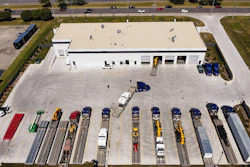
Saia has added 45 terminals since 2022 and relocated or expanded more than 25 others, lifting door count by about 32% and tractor and trailer capacity by more than 35%. The network now totals 219 terminals.
These investments have moved more than 60% of U.S. ZIP codes within a 50-mile radius of a Saia terminal—nearly double the coverage from 2017. Service metrics saw notable improvements as a result, highlighted by a company-record cargo claims ratio of 0.3%, which improved more than 40% year-over-year.
Terminals opened in 2023 and 2024 improved their operating ratio by 40 basis points year over year, and their operating income rose 22%, Batteh said.
Holzgrefe pointed out the terminals’ operating ratio are still running in the low 90s. “Although they improved year over year, they’re still below the company average in total.”
Cost inflation also impacted margins. Salaries, wages and benefits rose $46.7 million, or 11.6%, compared to a year ago. The increase reflected wage increases and higher compensation with improved company performance, though total headcount grew just 0.4%. Group health costs increased $2.3 million.
Fuel expense surged 55.2% year over year, reflecting a 48.1% jump in the national average diesel price. Claims and insurance expense fell 10%, and depreciation was flat at $64.1 million.
Truck and rail purchased transportation accounted for 15.7% of linehaul miles, up from 12% a year ago, with rail representing nearly 39%. The underlying rate per mile, excluding fuel, rose about 4%.
Looking at the fourth quarter, October shipments were up about 2% and tonnage about 10% year over year, in line with seasonal expectations.
Balance sheet
Saia ended the quarter with $202.5 million in cash and $100.0 million of total debt, compared with $35.5 million of cash and $219.2 million of total debt a year ago. Free cash flow for the first nine months reached $244.9 million, up from $11.6 million.
Net capital expenditures were $235.9 million through September, with full-year 2026 capex guided to about $350 million.