










Carriers were buzzing with excitement for the economy at the Truckload Carriers Association Truckload 2026 convention this past Sunday. But just as Mondays arrive to end weekend fun, Bob Costello arrived to burst that bubble the following morning.
The American Trucking Associations (ATA) chief economist has lovingly earned the nickname Bob “Cold Water” Costello for extinguishing the flame of optimism. He noted that while carriers are feeling more positive because market pressures and falling rates have pushed some fleets out of the industry and led to the downsizing of private fleets, that optimism should be tempered.
That contraction in capacity, along with the Federal Motor Carrier Safety Administration’s CDL policy changes, is moving the industry in the right direction, he said. But Dennis Dellinger, president and CEO of truckload carrier Cargo Transporters (CCJ Top 250, No. 167) and former ATA chairman, said during a panel discussion that Costello told him to temper his excitement.
And that warning goes for other carriers as well, Costello said, because the optimism is only reflective of supply-side corrections. Costello warned other carriers as well, explaining that current optimism is only reflective of supply-side corrections.
“There's not a ton of demand percolating up at this point,” he said. “I think you all have to remember what this industry almost always does when things start to get better: start buying trucks. What I'm here to tell you is I don't think there's going to be a lot more freight out there to support it.”
Economic effects on top sources of freight
Costello said he doesn’t think freight will fall, but there’s no tidal wave of it coming in either. That’s because households are drowning in a sea of high prices. While the inflation rate is slowing, he said households are looking at a different metric: the level of prices, which are still very high—up almost 28% since 2020.
The Consumer Price Index (CPI) was lower than expected in January and up only 2.4% year over year, which Costello said is only a few tenths higher than the Fed likes. However, the Producer Price Index (PPI), which measures selling prices and is considered a precursor to the CPI, surged in January.

And prices are expected to increase even more with greater inflation on the horizon from the delayed effects of tariffs, which didn’t have as much impact in 2025, Costello said, because supply chains purchased products ahead of time in anticipation of the tariffs and worked down those stored inventories throughout last year.
While the top 20% of households have continued to purchase products as usual, he said 75% of households are feeling the pressure of the economy weighing on them amidst an unemployment rate of 4.3% that doesn’t account for the many who are underemployed.
The idea behind the tariffs imposed by the Trump administration was to create manufacturing jobs. Instead, the U.S. lost 83,000 workers in manufacturing over the past 12 months because factory output was down due to weak consumer demand and said tariffs, Costello said. This occurred despite the Federal Reserve reporting a 1.1% increase in total manufacturing production in 2025. Minus the aerospace, computer and electronic equipment, and chemicals sectors, total production was down half a percent, he added.
Not only did the economy lose workers, but job creation was also severely lacking, totaling 181,000 for the entirety of 2025—the weakest year of job growth since the COVID-19 pandemic and well below the amount needed to maintain a stable unemployment rate.
“My point is we have what we call a K-shaped economy when it comes to households,” Costello said. “... So understand that, too, as you go back and look at your business.”
Just as some households are doing better than others, the same is occurring in retail. He pointed out that online sales remain strong, food shippers are doing “pretty good,” big-box stores are “not horrible,” and building materials stores continue to have a tough time.
A positive spin
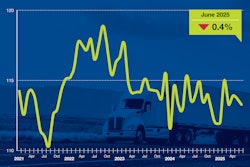
January was a good month for the truckload sector—the strongest month for truckload demand since October 2024, according to ATA data collected monthly across millions of loads.
“We are still down, contracting year over year, but I think we've sort of hit bottom here and hopefully start to come up a little bit,” Costello said. “You see that in the spot market; that is at low levels but turning the corner. ... I think things are moving in the right direction here.”
The spot market was up in January, and the spot market is generally an indicator for contract rates, he said, adding that average revenue per mile – excluding fuel surcharges – was also up in January. All of this points to a supply-based recovery.
“Demand-based recoveries are easy. All of a sudden, you just get a bunch of new freight. That's probably not what we're going through,” Costello said. “Supply-based recoveries are more difficult, but it is happening.”
Continued reductions in supply related to stricter CDL requirements, English language proficiency violations and the illegal use of B1 drivers will help move that recovery forward, he said, along with the fiscal policy of the One Big Beautiful Bill Act, anticipated Fed interest rate decreases and, of course, tax season.
Dellinger said he’s “seeing some good things” happening at Cargo Transporters, but that Costello told him it’s because of the non-domiciled CDL rule.
“I guess the key thing is for people not to get out there and add trucks,” Dellinger said. “We need to manage the capacity.”