










AI investment is critical to trucking's recovery, contributing significantly to U.S. GDP growth and driving demand through data center construction and manufacturing expansion. Without AI investment, the economy would face only 0.6% growth instead of the current 2.4%, making it essential for the trucking industry to overcome its prolonged freight recession.
- AI investment accounts for most of the U.S. GDP growth, with removal of AI investment dropping growth from 2.4% to 0.6%
- Data center-related construction is up 33.9% year-to-date in 2026, with an 73% increase year-over-year in August
- Manufacturing growth at 1.3% year-over-year is driven almost entirely by AI and aerospace sectors, which represent only 10% of factory output
- The trucking industry has seen a 12% reduction in carrier population over four years, with driver counts down 8% from 2022 peaks
- Regulatory changes, including FMCSA crackdowns and CDL school policing, are expected to drive further industry consolidation toward supply-demand equilibrium
It is difficult to overstate the importance of the artificial intelligence investment boom on the U.S. economy, and trucking by extension. Data centers and all they require—new infrastructure, construction, manufacturing and electrical equipment—have had a profound effect on the nation’s GDP in recent years. Year-to-date, that GDP number stands at roughly 2.4%.
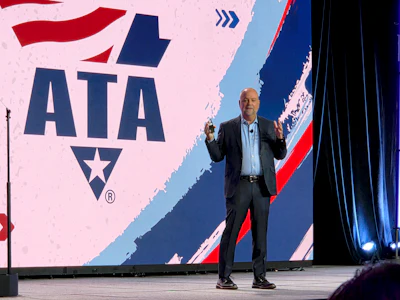
Without the AI investment, the GDP picture would be sobering. “If you take all of that [AI investment], add it up and take it out of the GDP numbers, you're left with 0.6% growth,” said Bob Costello, American Trucking Association’s chief economist at the 2026 ATA Management Conference & Exhibition in Charlotte, N.C.
Countering AI’s economic benefits are a host of barriers to growth. Inflation, rising interest rates and national debt, tariffs and war-related energy price increases remain major GDP headwinds well into 2026.
“If I knew nothing but those things, I’d probably say whatever economy you’re describing is in a recession,” he said, "but the balance to it is massive, and that is AI investment.”
Trucking is a major beneficiary of AI investment, particularly in manufacturing output and construction activity.
Manufacturing from January through September is growing at a rate of 1.3% year-over-year. “If that holds, and I think it will, you’re going to see that’ll be the best year in four years,” said Costello. But he noted that growth comes almost entirely from the AI and aerospace manufacturing sectors, which represent about 10% of all factory output production. Without those sectors, he said factory output would only be growing at 0.1%
The AI boom is reflected in construction as well. While total housing starts (-0.1%) and non-residential construction (-4.9%) are both in negative territory year to date, data center-related construction is up 33.9% so far in 2026 (Costello also said the August year-over-year comparison is a 73% increase). But non-residential construction falls to almost -8% when you remove data center construction activity.
Overcoming oversupply
The freight recession that began after the post-COVID freight boom ended in 2022 has largely leveled off across most trucking segments, but volumes and overall freight demand remain suppressed. Costello said the unprecedentedly long downturn cycle can be attributed to a slower-than-normal reduction in capacity that kept the industry from reaching supply-demand equilibrium.
“We did see capacity come out of our industry, it's just that fleets didn't feel it because it didn't come down enough to match up to where demand was,” said Costello.
Higher operational costs and lower rates have caused about a 12% reduction in the total carrier population in the last four years, but there is still room for further contraction. “We are in a cycle like we have never seen before, and it is all supply driven,” said Costello.
Excluding independent contractors, the total driver count has rebounded about 14,800 from the low earlier this year but is still down almost 8% – roughly 57,000 drivers – off the post-pandemic high in 2022.
Costello identified several other factors that will ultimately drive more drivers and equipment out of the market and propel the industry to the point of equilibrium, starting with the Federal Motor Carrier Safety Administration’s crackdown on non-English speaking and non-domiciled drivers that could drive an FMCSA-forecasted 194,000 CDL revocations.
Recent policing of sub-standard CDL schools will also squeeze the pipeline of new entrants into the market, and high diesel prices will continue to squeeze marginal carriers out of business.
The recent U.S. Supreme Court ruling in Montgomery vs. Caribe Transport II that opens up brokers to accident liability will also lead to more careful selection of carriers by brokerage firms and could drive carriers with poor safety records out of business sooner.