










Driven by soaring driver costs and a projected drop to $2.00 per mile by 2035, self-driving trucks are poised to cross the economic tipping point by 2028, forcing a restructuring of the entire supply chain.
- The 2028 Economic Crossover: Conventional U.S. trucking costs continue to climb with inflation, while autonomous operating costs are projected to intersect at roughly $2.60 per mile around 2028 and drop to $2.00 by 2035.
- Labor and Safety Pressures: Severe workforce turnover, high driver wages ($10,000 per month fully loaded), and rising crash fatality rates are creating powerful economic and public-interest pull for autonomous adoption.
- Competing Business Models: The market has coalesced around four distinct operating archetypes—OEM-led platforms, purpose-built AV platforms, autonomous carriers, and virtual driver-only software providers—battling for control of the value chain.
- Ecosystem Bottlenecks: While technical hurdles are cleared, widespread commercial scale remains gated by fragmented state regulations, evolving insurance liability frameworks, and supply chain infrastructure realities.
The economic tipping point for driverless freight might be closer than you think.
Autonomous trucking is projected to reach cost parity with conventional human-driven rigs at roughly $2.60 per mile around 2028 in the U.S., according to according to Kearney and MIT Mobility Initiative projections.
The average cost to operate a commercial truck rose 3.4% (an increase of 7.6 cents) in 2025, according to the American Transportation Research Institute, to a record $2.336 per mile.
By 2035, Kearney and MIT forecast the cost per mile for self-driving trucks to fall to about $2—a 49% drop from 2026—even as inflation pushes standard trucking costs higher.
That projected crossover, Kearney and MIT Mobility Initiative claim, is fundamentally reshaping the $900 billion U.S. trucking market, which carries roughly two-thirds of domestic freight tonnage across long-distance linehaul, regional distribution, and final-mile networks.
The economics of autonomy
The acceleration toward driverless operations is driven largely by high labor costs and demographic pressure. Fully loaded, a U.S. long-haul truck driver costs about $10,000 per month, roughly double European labor costs and four times those in the Middle East. With labor accounting for 40% to 50% of a conventional carrier's cost structure, reducing those expenses has become an existential priority for many shippers and intermediaries.
As autonomous fleets scale, two primary forces are driving costs down:
- Driver-equivalent efficiency: Remote-operator ratios are improving from one operator per 10 trucks to one per 20, and fixed R&D software costs are spread across significantly larger active fleets.
- Operating efficiencies: Sensor and hardware manufacturing scales, while autonomous trucks gain the ability to operate closer to 24/7 without traditional hours-of-service constraints.
Safety and labor pressures
Beyond the balance sheet, structural challenges in the conventional workforce continue to fuel the push toward autonomy. The average U.S. truck driver is 47 years old, and long-haul carriers face annual turnover rates near 90%. At the same time, safety remains a critical public concern; large-truck crash death rates stand at 1.62 per million miles—36% higher than standard motor vehicles—with fatalities rising 58% between 2009 and 2024.
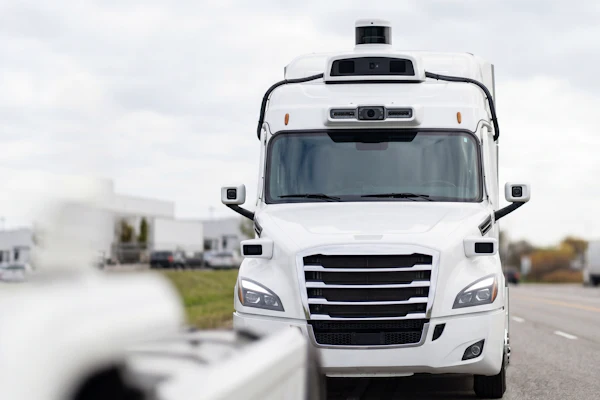
Companies such as Aurora, Waabi, Kodiak, and Bot Auto have logged hundreds of thousands of commercial and driverless miles, proving the technology works on public corridors across Texas, Oklahoma, and Arizona.


Competing business models
As the economics close, the freight market has divided into four distinct business archetypes jockeying for control of the value chain:
- OEM-led platforms: Major truck manufacturers integrating virtual drivers into trusted vehicle production and service networks.
- Purpose-built AV platforms: Cabless freight platforms designed for controlled environments like ports, railyards, and distribution hubs.
- Autonomous carriers: Freight providers managing the entire transport outcome and selling direct transportation-as-a-service to shippers.
- Virtual driver only: Asset-light software developers supplying the core autonomy stack to established fleets and manufacturers.
Despite technological milestones, widespread deployment still faces hurdles. State-level regulations remain fragmented—with states like Texas, Arizona, Florida, and Georgia leading the way in fully driverless operations—while insurers navigate complex new frameworks for liability allocation.
Ultimately, the debate has shifted from whether autonomous trucks can operate safely on public highways to which business models will successfully capture the massive profit pools unlocked by the 2028 economic crossover.