Trucking news and briefs for Wednesday, Dec. 3, 2025:
Daimler picks short-range LiDAR supplier for Torc autonomous trucks
 Daimler Truck
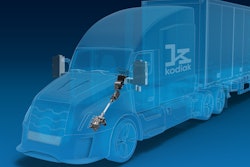
Daimler Truck and its autonomous-truck subsidiary Torc Robotics have selected Innoviz Technologies, a Tier-1 direct supplier of high-performance, automotive-grade LiDAR sensor platforms and complementary software stack, as its Short-Range LiDAR supplier for series production SAE Level 4 autonomous Class 8 trucks.
The announcement follows Innoviz's previous disclosure that a major commercial vehicle OEM had selected the company for future series production of Level 4 autonomous trucks, now revealed to be Daimler Truck.
Innoviz will supply its InnovizTwo Short-Range LiDAR sensors to support Torc’s autonomous commercial vehicle program. As part of a joint development effort, the companies will collaborate to advance the sensors for commercial trucking applications.
Daimler and Torc plan to integrate Innoviz’s LiDAR technology into the autonomous Freightliner Cascadia in combination with Torc’s virtual driver as one of several key components enabling Level 4 autonomous trucking. Deployment is planned across highway and regional routes in North America to help fleet operators improve operational efficiency and enhance road safety.
“This partnership with Daimler Truck and Torc represents a significant validation of our technology and our position in the autonomous trucking market,” said Omer Keilaf, CEO and co-founder of Innoviz. “The trucking industry demands LiDAR sensors that can perform reliably in the most challenging conditions while delivering the precision and range needed for safe autonomous operation. Our InnovizTwo sensors have demonstrated compliance with these stringent requirements, and we're excited to support Daimler Truck and Torc in bringing this transformative technology to market.”
“Selecting the right LiDAR partner is fundamental to our autonomous trucking strategy,” said Rakesh Aneja, Head of Corporate Development at Daimler Truck North America. “Innoviz's proven track record in automotive-grade LiDAR sensors makes them an ideal partner as we advance toward series production. This collaboration brings us closer to delivering autonomous trucks that will reshape the logistics industry.”



[Related: Daimler delivers new Cascadias to Torc for autonomous fleet testing]
FMCSA denies propane haulers’ wintertime HOS exemption request
A request from the National Propane Gas Association that would allow drivers hauling propane to drive longer hours during the winter months has been denied by the Federal Motor Carrier Safety Administration.
This summer, NPGA petitioned FMCSA for an exemption, that would have been valid Dec. 15 to March 15 each winter, to allow drivers to drive up to 12 hours a day and be on duty up to 15 hours a day, without weekly limits. It would also have replaced the 34-hour restart with a 24-hour restart, with prior notice by NPGA to FMCSA.
The agency noted that it received 31 comments on the request, 22 of which were in favor of granting the exemption with eight in opposition to it. Among those who opposed the exemption were the Owner-Operator Independent Drivers Association, Commercial Vehicle Safety Alliance, National Tank Truck Carriers and more.
CVSA said the exemption was unnecessary, and OOIDA said it does “not feel overly broad relief from HOS regulations is warranted for these types of operations.”
NTTC stated that its members are “unwilling to accept the legal and insurance risks” of using an HOS exemption and that “NTTC opposes blanket exemptions of certain fuel commodities over others.” NTTC concluded that granting HOS exemptions “potentially undermines our industry’s work and message of prioritizing highway safety.”
FMCSA in denying the request noted that it has an existing process for issuing emergency declarations and HOS waivers in the event of severe weather and other emergencies. Due to the hazardous nature of the material being transported and breadth of the exemption requested, the agency said it couldn’t determine that safety would be equivalent to or greater than the level without the waiver.
Emergency LED lighting manufacturer requests exemption from warning-device regulations
Intelligent Motorist Alert Messaging Systems (IMAMS), the maker of LED lighting systems that display emergency messages, has filed a petition with the Federal Motor Carrier Safety Administration for an exemption that would allow autonomous trucks to utilize its system as an alternative safety system for disabled trucks at roadside.
Current regulations require that truck drivers whose trucks are stopped along a highway to place warning devices, such as warning triangles or flares, around the stopped vehicle.
The IMAMS platform is a dynamic digital LED messaging sign that is securely mounted on the rear doors and front dash of semi-trailers and large CMVs. The company explained that, under its requested exemption, when an autonomous vehicle activates its emergency flashers, the IMAMS platform will automatically display a series of high-visibility, LED-lit messages to oncoming traffic. These messages cycle through "ALERT-ALERT" (in red), "MOVE OVER" (in amber), "SLOW DOWN" (in amber), and "DISABLED VEHICLE" (in amber), providing clear, immediate warnings.
The company said it believes its system is “superior” to the existing regulation because “it activates automatically, which eliminates the delay and risks associated with manual placement of triangles or flares.”
FMCSA is accepting comments on the request, which can be filed here through Dec. 31.
The agency recently granted a waiver to autonomous truck tech developer Aurora that allows the company to begin using cab-mounted warning beacons as an alternative to reflective triangles to meet federal warning device requirements.
[Related: FMCSA grants warning-device waiver to autonomous trucking company]
FMCSA grants driver-training regs waiver to Montana Trucking Association safety coordinator
The Federal Motor Carrier Safety Administration has granted an exemption to William Cole, the safety coordinator for the Montana Trucking Association, to allow him to provide hazardous materials (HM) classroom training without having at least two years of driving experience of the same or higher class and/or the same endorsement level for which training is to be provided, as the regulations require.
The exemption excuses Mr. Cole from the requirement to possess a commercial driver’s license (CDL) or have previously held a CDL.
In his request, Cole said he believed his qualifications “exceed the necessary knowledge and instructional standards for ELDT theory training” and included several credentials that he holds that he believed show his qualifications:
- CVSA Advanced Hazmat Instructor
- Certified Safety & Health Official (CSHO) - Construction
- Specialist in Safety & Health (SSH) - General Industry
- OSHA Outreach Trainer - Construction
- Member of the ATA Law Enforcement Advisory Board
- Facilitator of the Montana Trucking Association Safety Council
Because Cole will be limited to conducting classroom theory training and not behind-the-wheel training, FMCSA said it believes the exemption will likely achieve a level of safety that is equivalent to, or greater than, the level that would be achieved without it.
The exemption is effective through Dec. 2, 2030.