The American Trucking Associations (ATA) has called on the Environmental Protection Agency (EPA) to provide regulatory relief as the industry nears a 2027 deadline for strict heavy-duty engine standards.
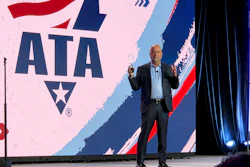
In a letter addressed to EPA Administrator Lee Zeldin, ATA President and CEO Chris Spear praised the agency’s recent "commonsense approach" to environmental regulation but warned that current nitrogen oxide (NOx) rules threaten to disrupt the national supply chain.
President Donald Trump earlier this month announced the rollback of the Endangerment Finding, which has allowed presidential administrations to regulate six greenhouse gases (carbon dioxide, methane, nitrous oxide, hydrofluorocarbons, perfluorocarbons, and sulfur hexafluoride) since 2009. The EPA's existing requirements for criteria pollutants, however—including NOx and particulate matter (PM)—remain in place and continue to be enforced independently of any changes to greenhouse gas (GHG) regulations.
The EPA has already pledged to revisit the details of the Biden-era 2022 Heavy-Duty Engine and Vehicle rule, which regulates NOx and other emissions beginning with Model Year 2027, promising to "make major changes to the program requirements while maintaining the Model Year 2027 start of the standards."
Those changes, however, are not widely expected to loosen emissions limits. Rather, they are expected to relax the requirement that OEMs extend warranties to 450,000 miles (up from 100,000) and useful-life limits to 650,000 miles (up from 435,000 miles)—two major drivers of added cost in 2027-compliant equipment.
Reliability gap
The ATA's concern is rooted in the unproven nature of new emission-control solutions required for Model Year 2027 engines. Spear noted that a lack of compliant prototype engines has slowed real-world technology trials typically required before major standards take effect.
"New emission control technologies required on model-year (MY) 2027 trucks are unproven on the highway, and the trucking industry is concerned that a premature rollout will disrupt our ability to efficiently move freight," Spear wrote. "The lack of compliant prototype engines and pre-production models has stalled the technology trials that normally precede major new emissions standards. Fleets’ inability to complete operational testing leaves them unable to plan for maintenance, training, or performance impacts."

In their quest for emissions compliance, OEMs have indeed made changes to their engines and aftertreatment systems, but most fall far short of reinventing the system itself.
For example, International, which had already eliminated the EGR cooler from the current design of its S13, said the 2027 S13 Integrated Powertrain carries over 90% of the hardware from the current platform.
Volvo Trucks’ Ultra-Low NOx CARB '24-compliant engine is built on the Volvo D13 Variable Geometry Turbo (VGT) platform. It utilizes a 48-volt alternator and a 10kW grid heater to maintain high exhaust temperatures, which reduces DEF crystallization and improves nitrogen oxide (NOx) conversion efficiency. While that engine is not EPA-2027 compliant, Volvo plans to debut its EPA 2027 D13 later this spring.
Paccar announced earlier this month that it would introduce two all-new proprietary engine platforms for 2027—"by far the most advanced powertrains in our history, simultaneously improving emissions, fuel economy, and durability," Chief Technology Officer John Rich told analysts at Paccar's investor meeting. The company did not elaborate on what the aftertreatment system might look like, but noted on the call its next-generation diesels were in the final stages of development and continue to undergo rigorous field testing.
Detroit will announce plans this week for its 2027 DD engine lineup, while Cummins has delayed the launch of its next-generation diesel.
Flexibility over mandates
Spear is urging the EPA to implement non-conformance penalties (NCPs), a provision of the Clean Air Act that allows manufacturers to sell heavy-duty engines that do not yet meet specific standards in exchange for being assessed a fine.
Spear contends this would give manufacturers additional time to run real-world testing on new emission-control systems and engine technologies. NCPs would allow the continued sale of "proven, environmentally sound technologies that deliver dependable emissions performance and reliability for fleets," Spear added.
Manufacturers can use existing emissions credits to cover penalties.
"Credit market flexibility can also ensure manufacturers remain in compliance while supplying proven technologies to the new truck market. ATA recommends EPA consider flexibilities that expand credit life, credit trading, and credit use across different vehicle classes," Spear wrote in his letter. "Credits earned represent real emissions reductions, and EPA should ensure credits are not unduly limited, discounted, or forced to expire."