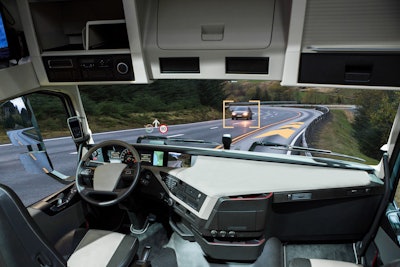
The proposed merger between Union Pacific (UP) and Norfolk Southern (NS) is rooted in fierce competition from motor carriers, other railroads, and—to a lesser extent—ships, barges, and pipelines. However, the move is also driven by a fear of the ongoing shift in trucking technology: specifically, driverless vehicles and advanced driver-assist systems.
"The rise in autonomous and semi-autonomous technology is a further challenge that the rail industry must meet head-on," wrote Jim Vena, Chief Executive Officer of Union Pacific Corporation, in the nearly 7,000-page merger application submitted Friday to the Surface Transportation Board (STB).
"And the challenge is about to intensify," added Kenny Rocker, executive vice president of marketing and sales at UP, and Ed Elkins, executive vice president and chief commercial officer at NS, in a joint application statement. "The trucking industry is moving quickly toward autonomous-vehicle technology, supported by federal research programs and state pilot initiatives. Lower labor costs, longer operating hours, and greater equipment efficiency will make trucks even more competitive."
The filing emphasized a stark trend: "The reality is that rail, as an industry, has been steadily losing market share to trucking for decades. Trucks keep getting faster, smarter, and more connected—and with autonomous technology on the horizon, that gap will only grow if we don’t act."
UP and NS in July announced an agreement to create America’s first transcontinental railroad – an $85 billion deal that connects more than 50,000 route miles across 43 states from the East Coast to the West Coast, linking approximately 100 ports and nearly every corner of North America. The deal still needs STB approval.
Trucking's head start
This urgency to unfurl this massive connected rail network comes as the trucking sector organizes and consolidates its autonomous efforts.
In November, a group of 28 organizations, including the American Trucking Associations, formed United for Autonomy, an organization dedicated to advancing a federal policy framework for autonomous vehicles (AVs) in the United States.


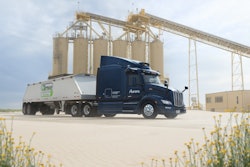
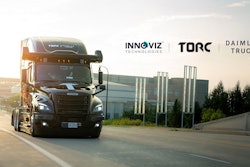
Autonomous truck tech companies have also accelerated their capabilities this year. In May, Aurora Innovation launched its commercial self-driving trucking service in Texas and added another lane in October. Aurora partnered with McLeod Software in September to integrate AV technology into carriers’ existing operations and help increase industry adoption of self-driving trucks.
Also in September, Roush Industries and developer Kodiak Robotics announced the delivery of the first Kodiak Driver-equipped autonomous trucks off the Roush production line; Bot Auto announced the successful completion of its first “humanless” hub-to-hub validation run in Houston, Texas; and International Motors launched customer fleet trials of its second-generation autonomous vehicles. In partnership with PlusAI, International will pilot its autonomous on-highway tractor along the Interstate 35 corridor between Laredo and Dallas with select fleet operators.
Rail’s Focus: operational vs. freight efficiency
Rail's deployment of autonomous technologies to-date has focused more on operational safety and maintenance than on freight efficiency.
Over the last five years, UP has expanded its fleet of manual and autonomous geometry testing equipment, resulting in a nearly tenfold increase in miles tested. During this period, UP recorded an 85% drop in geometry-related defects—clear evidence that the railroad’s data-driven approach promotes lasting, high-quality repairs. UP continues to expand this fleet annually and currently operates 15 autonomous systems across its network.
Other technological advancements cited in the application include:
- Automated Tie Unloaders: UP uses these to distribute crossties, reducing unloading time by 75% per tie car while nearly eliminating safety risks. NS does not currently possess this technology.
- Automated Rail Unloader: Debuting in May 2025, this system unloads rail 50% faster than traditional methods. Three additional units are under construction, with two expected in 2026 and the third in 2027.
- Infrastructure Assessment: Both UP and NS collect track geometry and infrastructure data via physical observation and autonomous sensors. This data is used to analyze potential defects, prioritize repairs, and build long-term capital investment strategies.