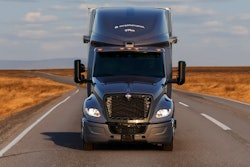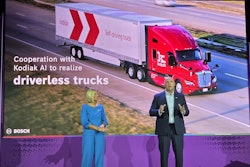










As announced at CES 2026, Bosch and Kodiak AI are teaming up to outfit Kodiak’s autonomous Class-8 solution with Bosch sensors and components to create a redundant autonomous platform. The partnership comes as Kodiak is readying production to deliver its first batch of autonomous trucks to Atlas Energy Solutions, a customer working in the Permian Basin in West Texas.
In this video, see why Kodiak selected Bosch as one of its major autonomous component suppliers and how the company is developing products across several verticals, including defense, passenger car and transportation markets.
Contents of this video
00:00 Kodiak partners with Bosch
02:19 Hardware for the autonomous platform
03:43 What makes Bosch the right partner for Kodiak?
04:12 Which OEMs will Kodiak work with?
Speaker 1:
So we've been around for a little over eight years. We're focusing primarily on AI software as it applies to physical systems like the truck behind me. We actually work on a wide range of vehicles. We have everything from passenger vehicles like Ford F-150 pickups, all the way up to class A trucks. We also work in the defense industry where we've outfitted vehicles with treaded tank like a control system. So it's a very agnostic autonomy platform, really focusing on the AI software component. We don't build the hardware. We partner with great companies like Bosch that can supply us the components that we need to make this dream a reality. We have three main verticals that we focus on. So we have long-haul trucking. So this is a long-haul truck that you see behind me. We have industrial trucking, which looks a lot like a long-haul truck, but with some reinforcements underneath.
And then we have defense. Our first driverless deployments are in production and live, owned and operated by the customer today. Our launch customer is a company called Atlas Energy Solutions. They're based out in the Permian Basin of West Texas. That's the oil and gas fields. So they're a track sand, a hauling company. They mine the sand, they put it in a big truck, and then they use that truck to transport its oil and gas wells throughout the region. So those are anywhere from 20, 30, 40 mile trips on very rugged and tense roads. One of the things that we pride ourselves in at Kodiak is their ability to handle unstructured autonomy. So we don't necessarily need structure in the environment like lamp posts and walls and buildings and other things that a lot of autonomy companies use in order to what we call localize and figure out where you are and where you're going.
We have a much more generalized real-time AI system that figures out how to drive based on the context. And that's important when you're talking about a single AI system that works across those three verticals. You have a highway, very structured environment. You have industrial, which is by definition unstructured. Then you have defense, which is completely who knows what. Could be anything. And our autonomy system has to handle it end to end. We're really excited to be here with Bosch, especially at their booth. We announced the collaboration yesterday. And as you know, Bosch is a global leader in automotive supply. So there's just absolutely no better partner for us to work with in the future as we look to scale this solution. We haven't specified that yet, but the nice thing about Bosch is that they're a one-stop shop for pretty much every component we could possibly want.
Everything from platform components like steering, braking, internal systems to sensors like radars and cameras to compute systems to wiring harnesses to pretty much everything in between. And so while we haven't kind of publicly disclosed what the package looks like, you can imagine that we want to leverage Bosch's capabilities as much as we possibly can.
Speaker 2:
The only thing I'd like to add is that also from the Bosch perspective, it is a great opportunity to work closely, collaborate with Kodiak on this technology. Bosch's motto is invented for life and vehicles like these make everyone's life better, one from the safety point of view because an autonomous level four truck never gets tired, is consistent much more than a driver. And then another topic, I mean, we hear it a lot in the news. Things are getting more expensive at supermarkets. When you have efficiencies of scale that these vehicles, this technology can bring, because again, you can run them a lot longer. You don't have the driver shortages, et cetera. It's something that the end consumer can feel. So great opportunity to work with Kodiak on essentially technology that is for everyone to see the benefit and where Bosch can show what Don just mentioned, the broad portfolio product.
Speaker 1:
One of the things that's so great about Bosch is they already work with everyone. They're already ingrained in the automotive supply chain at the OEM level, and they work with a broad range of different makes and models of vehicle, different sizes of vehicles. And so we have designed our system to be platform agnostic from the very beginning. And so I think this is a really good combination between the two companies. Our goal is to meet the customer where the customer is. If you are familiar with the trucking market, you'll know that trucking carriers want to multi-source from different suppliers. They don't want to be beholden to one OEM in particular. There's many reasons for that. And so our goal is to work with the ecosystem more broadly. It's not about us choosing favorites. It's about us supplying to the market, and that's what really Bosch allows us to do.
I would say V2V would be a great thing to have. It would make the solution more accessible, but it doesn't exist today. So we cannot rely on it. Just kind of that initiative has not gone that direction, which means every vehicle that we deploy has to be fully independent, has to be able to be capable of working without any kind of support effectively. We do have constant communication to our vehicles. We have the ability to monitor the trucks when they're in the field. We do that through a series of communication protocols such as LTE, 5G. We even have Starlink on the vehicles. And so for remote places like the Permian Basin where you don't always have good coverage, but that is not required. I think that's an important distinction, at least with Kodiak solution, is that our safety case does not require active monitoring of a remote human.
That's, I think, not true of all autonomy programs, at least at this stage. And that's something that we're really proud of. These trucks truly are out there independent with nobody watching, or at least nobody required to watch. We do often have somebody watching, especially at small scale, but it's not an inherent requirement of the system.