









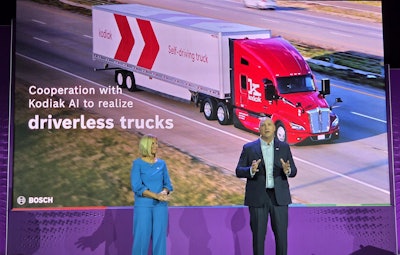
Kodiak AI announced it will partner with Bosch for the manufacture of the autonomous truck developer’s redundant autonomous platform as the company begins to scale commercial vehicle production.
Under the terms of the agreement, Bosch will support the development of a redundant autonomous platform that combines integrated automotive-grade hardware, firmware, and software interfaces for Kodiak’s AI-driven autonomous platform, called "Kodiak Driver."
“By supplying production-grade hardware, we are enabling the next generation of autonomous trucking alongside Kodiak,” said Paul Thomas, president of Bosch in North America and Bosch Mobility Americas. “Kodiak has already deployed trucks with no humans on board in commercial operations, and this cooperation gives us a valuable opportunity to deepen our understanding of real-world autonomous vehicle requirements and to further enhance our offerings for the broader autonomous mobility ecosystem.”
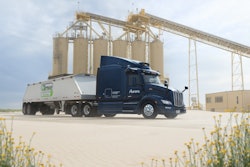
Last year, Kodiak delivered the first batch of its 100-truck autonomous vehicle order to Atlas Energy Solutions, which operates the tractors in fracking operations in Texas’s Permian Basin. Kodiak currently works with ZF for steering columns and NVIDIA for AI assistance. The Kodiak Driver systems are installed in an upfit program by Roush Industries.
 Kodiak's Don Burnette explains the company's agreement with Bosch during a press conference at the 2026 Consumer Electronics Show in Las Vegas.
Beyond the industrial application for Atlas Energy Solutions, Burnette said Kodiak continues its highway-based program running routes between Dallas and Atlanta, Houston and Oklahoma City. Trucks on those routes still operate with a safety observer onboard, but Burnette said the company plans to operate without a safety observer as early as the second half of 2026.



“We have great partners like J.B. Hunt, Werner Enterprises, C.R. England and others that we've worked with on a daily basis for several years now to help them understand [autonomy] and help us learn their needs and train them on using the autonomy system,” said Burnette. “Now, with a safety observer, there's always room to leverage that person in the vehicle for certain parts of the task, and it really isn't until you've totally pulled the driver and there's nobody in the cab that you get the full experience of what it's going be like from a carrier perspective to operate a driverless vehicle.”
Burnette also said Kodiak’s deployment of next-generation autonomous technology layered with artificial intelligence has allowed the company to think beyond a hub-to-hub autonomous concept and toward a system that works dock-to-dock at distribution centers, warehouses and other customer locations.
“You still need people to hook up the trailer, to disconnect the trailer, to do the inspections,” said Burnette. “But our model really focuses on the customer’s needs, which is the end-to-end solution. There's some training and processes involved, but I think that's really going to be the way that you can penetrate the market and scale the technology. Imagine if you can reduce the time it takes to go coast to coast from four days to two days, right? That's going to have a profound impact on the way people think about moving freight.”