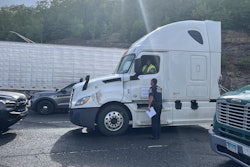











CDL drivers will now receive an out-of-service (OOS) order if they fail a roadside English language proficiency (ELP) test, following President Donald Trump’s Feb. 3 signing of a bill that codified his ELP executive order in law. But it’s up to roadside inspectors to determine if the driver is in violation of the recent Federal Motor Carrier Safety Administration (FMCSA) regulation change.
That means fleets are under pressure to comply with regulations where enforcement is not uniform.
Rob Abbott, vice president of corporate strategy at Fleetworthy, asked compliance experts during a recent webinar, “Can you be sure that a driver who passes the test in California will pass it in Florida or any other state?”
Steve Keppler, co-director at Scopelitis Transportation Consulting, said the short answer is “no” because “it’s a subjective rule,” and there is variability in the questions roadside enforcement officers can ask, which is what’s resulting in violations.
This places a heavy burden on fleets to test new drivers and re-test existing drivers for ELP, while leaving them in the dark as to whether those methods are enough to meet compliance standards.
“Be uniform in your evaluation. Don't be selective because you're opening yourself up, and make sure you document everything … because we will have inconsistent enforcement,” Keppler said.
Ensuring ELP compliance
During the “Fleet Compliance: What 2026 Will Demand from Fleets” webinar hosted by Fleetworthy, Brandon Wiseman, president of TruckSafe Consulting, advised fleets to establish processes and controls within their driver vetting process that include ELP. He said it can be as simple as having a conversation with the applicant to ensure they can communicate in English.
“If you hire them, and then they get tagged with one of these violations roadside, or you end up in highway accident litigation, and you're called to task for ‘Hey, what'd you do to make sure that they were proficient in English,’ then you've got some documentation to show the controls you had in place,” Wiseman said. “At the very least, on a go-forward basis, I'm recommending my fleet clients do something like that.”

Abbott said there is a non-redacted version online of the FMCSA’s ELP test it recommends law enforcement use during inspections. He said fleets may be able to find that and use it to test their drivers.
The process is different for existing drivers. He said it depends on individual fleets’ bandwidths to bring drivers back in for testing.
“Maybe you have some kind of a stopgap measure where your dispatchers are on the phone with them, and they can be your first line of defense here to alert you to any problems,” Wiseman added. “Then those that get alerted, maybe you bring back in and you go through the process again.”
But he urged fleets to be mindful about their testing process.
It’s better to pull every driver for testing as opposed to targeting specific drivers based on whether you think they will pass, for example, because of their last name or how they look. This could lead to employment law issues.
The biggest takeaway, Keppler said, is that fleets need to document everything they’ve done to ensure their drivers are meeting the standard – not just ahead of a violation but training done afterward in the event of a violation
“Drivers obviously don't get inspected all the time. They may get stopped today, they're good, but next month or six months they could be put out of service,” Keppler said. “Then you have that evidence that you can submit and file a DataQ challenge.”
Impacts coming to CSA Scores
Fleets flagged for OOS violations will want to challenge those because FMCSA has proposed several significant changes to CSA score measurement. And ELP and CSA scores are impacting fleets' relationships with shippers.
Wiseman said FMCSA has not yet issued a rulemaking on these changes because it was bogged down last year with ELP and non-domiciled CDL changes, but Keppler said he expects to see that happen this Spring.
One of those changes is the way severity weights are assigned per violation.
Wiseman said there is currently a severity scale of one to 10 for the over 900 conceivable violations. The recommended change is a severity weight of either one or two, depending on whether it's an OOS violation or not.
“Your out-of-service violations are going to have an outsized impact on your score,” Keppler added. “It puts more emphasis on out-of-service conditions. I just want to make sure fleets are aware of that.”