










Despite a 5% technical failure rate and ongoing system transitions, safety officials maintain that Motus is effectively advancing carrier vetting and cracking down on fraudulent trucking operations.
- Motus Vetting and Fraud Prevention: The registration portal verifies real business owners, reviews principal places of business, and targets fraudulent "chameleon carriers" attempting to hide behind multiple DOT numbers.
- System Hurdles and Adjustments: Transitioning away from legacy systems created technical challenges, prompting FMCSA to temporarily suspend mandatory biennial updates to clear backlogs.
- Performance and Support: Agency officials report roughly 95% registration success through Motus, while deploying dedicated support teams to assist the 5% of carriers experiencing technical friction.
- Broader Enforcement Efforts: Alongside the Motus rollout, the agency is aggressively purging non-compliant training providers and electronic logging devices (ELDs).
Federal motor carrier regulators are leaning heavily on Motus, its modernized registration portal, to purge fraudulent Chameleon Carriers from the highway, even as the digital overhaul works through persistent technical growing pains.
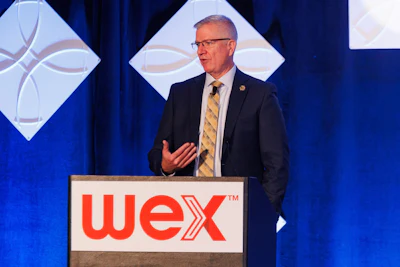
Addressing trucking executives Wednesday at the WEX OTR Summit at the Marriott Sawgrass Golf Resort & Spa in Ponte Vedra Beach, Florida, Federal Motor Carrier Safety Administration (FMCSA) Chief Safety Officer Steve Dowling outlined how the agency is harnessing cross-system data to police five lifecycle stages: driver training, licensing, carrier registration, fleet operations, and enforcement.
"Safety’s not a competition," Dowling said. "There’s room in the industry for everyone that wants to play by the rules, but we also need to learn from each other."
Dowling, a veteran law enforcement officer who spent more than 30 years with the California Highway Patrol and later served as director of safety at Covenant Logistics before joining the agency in August, noted that regulators are targeting systemic abuses rather than penalizing minor paperwork errors.
"Our goal is not to spend time with the ones where you’re already investing and you’re compliant," Dowling said. "We have limited resources, so we want to make sure that we’re focusing on the carriers that need the most attention and/or may not even be trying to be compliant."
To further root out organized fraud networks, FMCSA has partnered with the Department of Justice, the FBI, and federal prosecutors to establish interagency task forces, but its the overhaul of FMCSA's carrier registration system that the agency has placed at the tip of its spear. It's also has drawn the most ire from motor carriers.
"We had a lot of legacy systems that we're working through updating, but all are coming into what we now call Motus," he said, "which is allowing for actual identification of who our owners are. It's evaluating the principal place of business to see if there are redundancies that might be an indicator that we need to do follow-up."

While acknowledging system-transition flaws that forced the agency to temporarily suspend mandatory biennial updates, Dowling said the upgraded portal has succeeded in keeping thousands of bad actors off the road.
"We have about 95% of the carrier registration that’s going on in Motus working," Dowling said. "If you’re part of that 5%, that’s still a challenge. That’s not acceptable to us, but there are thousands of people that we're keeping out of the industry because we've initiated Motus... that the purpose behind it, the intention. It's working. It's not working as well as we want it and as smoothly as we want it, but we're getting there. And it's necessary, and it is so essential to having that level playing field as we move along."
To mitigate the friction, Dowling noted FMCSA staff has set up direct assistance channels to help compliant carriers navigate registration hurdles while the agency fine-tunes system updates.
Sweeping training and device removals
The regulatory offensive has also fallen heavily on entry-level commercial driver training programs. Since December 2025, FMCSA has purged more than 10,000 providers from its official Training Provider Registry. In August alone, emergency interventions shuttered 110 schools, an action that affected roughly 5,000 commercial drivers.
English language proficiency was central to the emergency removals, Dowling said, emphasizing that inspectors are looking for functional communication rather than fluent speech.
"When I was an inspector and I’m getting ready to crawl under a truck... I want to know that when I tell the driver to step on the brakes and hold it while I’m going underneath to take measurements, they understand what I’m saying," Dowling said.
Agency scrutiny has extended into daily cab technologies. Regulators have removed more than 100 non-compliant electronic logging devices (ELDs) from the certified registry and barred roughly 600 others from entering the market, with investigators reviewing reports of carriers altering drive logs over the phone.
Flexibility and future rules
Looking ahead, Dowling indicated the agency wants to avoid overly rigid mandates when practical safety alternatives exist.
The FMCSA is conducting a pilot program evaluating added hours-of-service flexibility for sleeper berths and the standard 14-hour driving window.
"Regulations create guardrails, but it’s not to define how every business operates," Dowling said. "Compliance alone does not guarantee that a driver is not fatigued. We need to look at it and see if there are other ways to accomplish it that work better with the industry."
The agency also plans to introduce updates to its Safety Measurement System (SMS) and will seek public comment from motor carriers in the coming months.