










Grocery store shelves have been stripped of milk and bread in preparation for the winter storm that is expected to affect a large geographical portion of the U.S. over the weekend and into the following week.
But as millions of people gear up to huddle down in their homes, many truckers will be on the roads. The tech vendors that serve the trucking industry are already prepared to help truckers and dispatchers manage operations through the storm and its icy aftermath.
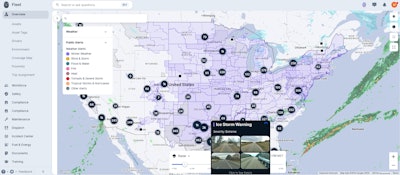
Fleet safety platforms Samsara and Motive are actively monitoring roadway conditions across impacted regions. Both platforms provide real-time weather overlays on GPS, giving fleet managers insight into impacts on routes. This gives them the ability to not only alert drivers before they enter a storm but also proactively reroute drivers to avoid hazardous conditions.
“Throughout the storm, this continuous monitoring and communication enables fleets to protect drivers, reduce delays, and keep operations moving safely and efficiently,” said Gary Johnson, head of safety and compliance strategy at Motive.
According to Motive’s 2026 AI Road Safety Report, collision risk is at its highest during winter months because weather conditions like snow, rain, and ice reduce traction and visibility. The report says early sunsets, cold weather, and long shifts increase drowsy driving, compounding risk.
In the event of a collision, Motive’s first responder service automatically alerts emergency services and pinpoints the driver’s location, but the goal is to prevent accidents altogether with tools like weather overlays.
“After looking at the weather overlay in Motive, I gave one of our drivers a heads-up that he should take cover,” said All Chemical Transport Corp. dispatcher Tom Grille. “That weekend, my driver called to thank me because later he saw the damage from the tornado. He was safe at home at the pool with his grandchildren.”
Johnson said the road and weather conditions context is paired with GPS, telematics, and video insights from tools like AI Dashcam Plus that can detect early warning signals of near-collisions to intervene before an accident occurs. Samsara’s AI dashcam also pairs with data from weather feeds and telematics sensors to proactively prevent collisions.



The platform also dynamically adjusts safety thresholds when it detects bad weather. Johan Land, senior vice president of safety and AI at Samsara, said driving at a 65-mph speed limit may be safe on a sunny day, but it’s a hazard in a snowstorm. The system distinguishes that and automatically adjusts the safety thresholds—like speeding alerts and following distances—based on real-time weather conditions.
“We don’t just know it’s raining; we help the driver adapt to the rain,” Land said.
And the platform can also see the rain coming. Beyond real-time weather overlays, the provider offers advanced insight into on-the-ground conditions through its network of connected vehicles and their dash cameras with coverage across 99% of major U.S. roadways.
The solution, called StreetSense, pulls images from dash cameras (with customer-identifying information removed) to give fleet managers insight into what’s happening on a precise stretch of road, whereas a weather app can only provide aerial information, and forecasts can be wrong.
“It gives you eyes on the ground, not just where your drivers are, but where your drivers are headed—so you can stay miles ahead of weather events,” Land said.
WeatherOptics’ software also takes a ground-level approach to its predictive routing model.
WeatherOptics founder and CEO Scott Pecoriello said snow and ice don’t disrupt operations uniformly. Risk varies dramatically by route, elevation, traffic volume, road treatment, and timing; therefore, the platform focuses on route- and asset-level monitoring.
“As this storm approaches, the biggest challenge for trucking companies isn’t simply knowing that winter weather is coming,” he said. “It’s understanding where, when, and how conditions will actually become unsafe for drivers and equipment.”
Pecoriello said the platform’s trucking clients have been receiving daily automated AI storm briefings, which tell them exactly which trucks, assets, and shipments are going to be in the "danger zone" over the next seven days. He said it allows them to make quick decisions on things like when road segments are likely to deteriorate below safe thresholds, which corridors are most likely to see closures or severe slowdowns, and which terminals or yards face higher exposure.
“In advance of this weekend's storms, our trucking clients have already been proactively planning which specific loads and shipments to shut down or delay, sending early alerts to customers about delays or changes in orders, and letting drivers know well ahead of time when and where operations will shut down and reopen,” he said.
While fleets prioritize safety over schedules, Johnson said Motive’s platform is just as much about managing the operational strain winter weather brings.
[RELATED: Weathering logistics disruptions: Integrating weather into platforms for logistics decision making]
Motive’s maintenance tracking system informs fleets on things like tire condition, battery health, and antifreeze levels, and it uses automated schedules and real-time diagnostics to flag issues. Samsara also monitors battery and engine health as well as fuel to prevent drivers from being stranded with a dead truck in freezing temperatures.
The two providers are also monitoring the health of their own systems to ensure connectivity throughout the storm, with the ability to switch to alternative carriers in the event of an outage.
While it may be too late to implement some of these technologies ahead of this storm, there is plenty of weather ahead, and Pecoriello said it’s important to plan for that. And those with weather technologies may still not be fully prepared.
From a preparation standpoint, Pecoriello said the most important thing fleets can do on the tech side is ensure weather intelligence is integrated into operational workflows, not siloed in a separate dashboard. That means tying weather risk to specific routes, trips, drivers, and facilities, setting clear thresholds for action, and making sure teams know what decisions should be triggered when those thresholds are reached, he added.
“Winter weather is unavoidable, but the operational disruption doesn’t have to be,” Pecoriello said. “Fleets that plan ahead using predictive, impact-focused weather intelligence are far better positioned to protect drivers, avoid preventable incidents, and maintain continuity during events like this.”