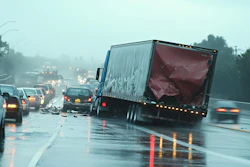











It’s spooky season; the time of ghosts, witches, pumpkins and … ever-so-eerie fog. Fall brings peak fog-forming weather as temperatures shift, and the Federal Highway Administration estimates that fog causes more than 38,000 crashes and more than 600 deaths each year.
As California approaches the November anniversary of a 2007 108-vehicle pileup that included 18 big rigs along State Route 99 just south of Fresno, the California Highway Patrol (CHP) and the California Department of Transportation (Caltrans) have partnered with a company to test its fog mitigation technology at the Caltrans Dynamic Test Facility (CDTF) at the CHP Academy in West Sacramento.
"The California Highway Patrol is committed to exploring innovative technologies that have the potential to make California's roadways safer," said CHP Commissioner Sean Duryee. "Fog and other low-visibility conditions can create serious hazards for motorists. Testing emerging technology in a controlled environment allows us to evaluate its potential to improve roadway safety."
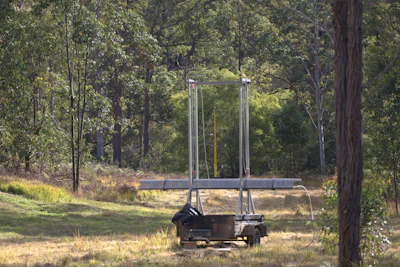
This partnership gives Rain Enhancement Technologies (RET) access to the testing facility to pilot its FREA (Fog Removal by Electrical Activity) system, which is an extension of the work the company has already been doing with its WETA (Weather Enhancement Technology Array) platform.
 The FREA, or Fog Removal by Electrical Activity system, emits negatively charged ions to reduce fog and enhance visibility.Rain Enhancement Technologies
The WETA system is already in use across multiple locations in the U.S., including one site outside of Moab, Utah, where it is used to enhance rainfall to help solve drought problems. The ground-based WETA structure uses electrical charges from solar panels to emit negatively charged ions into the air to stimulate 10% to 20% greater rain or snowfall.
RET CEO Randy Seidl said this technology has been around for over 60 years and is heavily researched and proven. Now, instead of enhancing rain and snow, RET is extending that technology to minimize fog and related traffic incidents.
“If you think about the same technology relative to fog, fog is basically zillions of molecules, so it helps those come together, get bigger, and then drop such that it clears out a line of sight,” Seidl said.
He said he thinks the reason the technology hasn’t been acted on before is because it previously didn’t exist in a way that would allow for remote and autonomous control. Rather, a person would need to be dispatched to the device’s location to turn it on and off.
The partnership with CHP and Caltrans enables RET to perform real-world testing to discover what FREA looks like in action.
The WETA system can affect weather in upwards of a 360-square-mile polygon. Seidl said the RET team thinks it can eliminate or diminish fog within up to a couple-mile stretch of highway.
RET will place, operate and monitor FREA equipment at the CDTF to gather field data on the system's ability and refine the technology.
The goal, Seidl noted, is for transportation organizations like CHP and Caltrans to acquire this system to target known fog zones to reduce accidents. He highlighted RET’s recent success with preliminary field trials of FREA in Australia.
Additional details regarding the partnership will be shared as testing progresses.