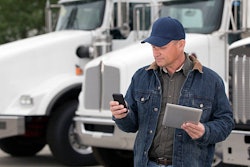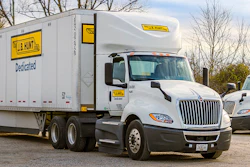











Truckers’ jobs are at risk—at least in the long term.
That’s what the CEO of Geotab said this week as he laid out his predictions for the coming years as 2026 approaches. Autonomy is nearing its own “AI moment,” a tipping point similar to the one AI crossed this year, according to the fleet management platform’s CEO.
“I do think that in the long term, all truck drivers are in trouble, unfortunately,” Geotab CEO Neil Cawse said. “Now, how long is that term? We have to see.”
Cawse said that if he had to put a number on it, he anticipates low adoption rates two to three years down the road, followed by a sudden ramp-up in five to seven years. And the quick evolution of AI, which is key to autonomous driving, is spurring that.
In the meantime, AI is positive for the driver, Cawse noted, because it lightens their workloads. For example, AI enables drivers to perform DVIR inspections more easily by simply taking a video of their trucks. In addition, he said live coding and new software development techniques facilitated by AI will make the apps drivers use simpler to operate. Among other benefits, he predicts AI will automate processes at border crossings and weigh stations, reducing driver wait times.
However, the benefits will favor some more than others—at least at the start.
“I'm quite optimistic. I think the benefits [will go] to the very large companies first, because they have a little bit more of the wherewithal to build the stuff, and then I think the smaller companies are going to get hurt in the shorter term, but then all of that stuff is going to be democratized,” Cawse said. “That's the one good thing about AI: you're going to get these AI startups that can then bring all of that service to the smaller companies.
“Then I think you may get an explosion in the smaller guys because now you don't need to have a big company. You can use all this AI to take a couple of trucks and turn them into a really good business that's quite efficiently run because of all the AI,” Cawse added.

However, those AI startups will quickly become obsolete, he warned.
He said 2026 will mark the end of AI as a tool and the beginning of AI as an operational partner running core fleet workflows. Fleets that fail to integrate AI will be left behind, he said. As the tools evolve, Cawse shared these recommendations for trucking companies:
Digitization is key. The food for AI, he said, is data, so companies that have all their data sitting on paper and not in electronic form will be at a disadvantage from using AI, and that will hurt them tremendously.
Another piece of advice he offered to be prepared for the changes in AI tools is to create documents around processes to teach new AI models instead of starting from the ground up. For example, he said create a document on what fleet management is, how to maintain vehicles, day-to-day things a fleet manager does, views on safety, etc.
It's about “making sure we have curated data sets that we can then just throw at the next AI that comes up,” Cawse said. “We just go, ‘here's the document. Go teach yourself.’”
And thirdly, become an AI expert yourself, he said. The key is to use AI regularly and understand prompt engineering.
Another prediction Cawse gave is that AI will shape the economy in a way we haven’t seen before.
“The next thing that we're starting to see is kind of this K-shaped economy, which is really the economy will feel like a recession and a boom at the same time,” he said.
This is because some companies will leverage AI efficiencies to improve quickly, while others will fail to do so. He noted that this initially means less competition, as smaller companies struggle to keep up. However, that will ultimately change.
Cawse said the beneficiaries of AI will start at the top with the producers of AI like NVIDIA, followed by the producers of the software and run data centers like Google. Then come the Geotabs of the world, meaning the companies that can trade in the vast amounts of data that AI operates on.
“I'm absolutely convinced that in three years, five years down the road, we're going to have an absolutely steaming ahead economy because every single company in the world is going to be able to benefit from AI,” Cawse said.