










Steering clear of regulatory fines and legacy engine extensions, Daimler Truck plans a complete North American rollout of its next-generation, EPA27-compliant powertrain platform in 2027.
- Full EPA27 Compliance: Daimler Truck will completely switch to its new engine platform in 2027, declining to run parallel legacy production or rely on Non-Conformance Penalties (NCPs).
- Simplified Engineering: The new engine architecture meets stricter emissions targets without requiring a complex 48-volt electrical system, helping curb manufacturing and incremental unit costs.
- TCO Improvement: Operational efficiency gains are expected to yield a 3% Total Cost of Ownership (TCO) advantage for fleet customers compared to previous engine iterations.
- Strategic Footprint Shift: The engine strategy coincides with North American manufacturing adjustments, including a new greenfield U.S. plant planned for 2029 and the closure of its Portland facility.
Daimler Truck North America-owned engine manufacturer Detroit isn't looking back when it looks to the future.
The company will fully transition its North American heavy-duty diesel lineup to EPA27-compliant engines at the start of 2027, rejecting parallel production schemes and non-conformance penalties to bridge the upcoming emissions regulatory shift.
For the 2027 model year, tailpipe nitrogen oxide (NOx) limits will drop by more than 80%, and particulate matter limits will fall by 50%.
Environmental Protection Agency (EPA) in July published a proposal to revise regulations for commercial truck NOx 2027 model year, leaving the NOx and PM limits intact, but expanding the availability and flexibility of the credit system manufacturers use to meet regulatory averages; permitting manufacturers to pay non-conformance penalties as a short-term alternative if they cannot immediately meet the hardware standards; and granting manufacturers more time to validate the reliability of new emissions-control systems under real-world operating conditions.
A number of OEMs have announced plans to take advantage of the reprieve, among them PACCAR and Cummins, the latter of which will introduce its new HELM platform engines—the X10 and X15—through a gradual production ramp starting in January 2027, while keeping select current-generation engines available during the transition.
Speaking during the company’s Q2 2026 earnings presentation, Chief Executive Officer Karin Rådström and Chief Financial Officer Eva Scherer confirmed that the manufacturer will phase out its current 2026 engine platform in favor of a newly engineered powertrain built to meet the more strict standard.
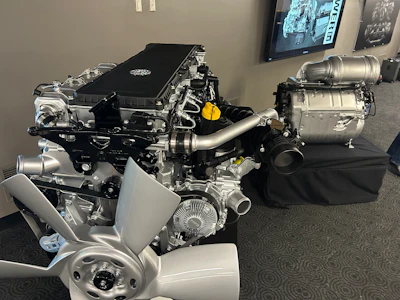
Detroit is utilizing a pre-selective catalytic reduction (pre-SCR) system. Positioned upstream of the primary aftertreatment system (ATS), this helps the engine reach operating temperatures faster—a critical factor in reducing emissions during cold starts and minimizing the need for parked regens. Since the pre-SCR system introduces DEF ahead of primary aftertreatment, it takes advantage of exhaust heat before the ATS gets to operating temperature. Hardware and functionality are nearly identical to the SCR in use since 2010.



Rather than relying on higher-cost electrical additions or paying regulatory fines for higher-emission engines, Daimler’s technical solution, Rådström said, achieves compliance while minimizing structural complexity.
"We will change over our production to the new engines. We have what we believe to be extremely robust engines, very good technical solution," Rådström stated. "We don't need the 48-volt system, which means the incremental cost increase is not that high. We also will have a TCO advantage with these engines of around 3%."
Scherer added that the company maintains a deep bench of NOx credits accumulated from its current engine family—which already perform below minimum legal emission thresholds—offering added flexibility during certification. However, she emphasized that the company expects no financial penalties when the new platforms launch.
"We do not expect any non-conformance penalties having to be paid for our EPA27 compliant engine, because we will be fully compliant with the engine that we launch beginning of next year," Scherer said.
The regulatory update comes alongside broader adjustments in North America. DTNA earlier this month announced plans for a new state-of-the-art U.S. manufacturing facility scheduled to begin production in late 2029, paired with the structural closure and restructuring of its legacy Portland, Oregon, plant.