











Transportation fleets are moving artificial intelligence beyond corporate hype into practical operations, using AI agents to automate back-office tasks like invoice processing and log auditing, streamline driver recruitment, and enhance fleet safety without eliminating jobs but rather reallocating employees to higher-value strategic work.
- Agentic AI is transforming logistics by automating tedious back-office duties including log auditing, driver management, load entry, and cash application across transportation companies.
- Automated agents now handle 85-90% of invoice matching, accelerating billing cycles and freeing employees from laborious data entry to focus on strategic work.
- AI-powered recruiting agents engage applicants on mobile devices immediately after submission, gathering missing information and speeding up the driver onboarding pipeline significantly.
- Fleet leaders emphasize security and system containment, building AI agents narrowly with limited access following the cybersecurity principle of least privilege.
- AI adoption is scaling operations and reallocating talent rather than causing layoffs, shifting employees from mundane tasks to high-judgment, meaningful work that drives business growth.
Artificial intelligence is rapidly shedding its label as corporate buzzword and taking root in the transportation sector, industry leaders said at the WEX OTR Summit in Ponte Vedra, Fla., last week.
Panelists emphasized that AI is transitioning from conceptual hype to practical operations, with companies deploying automated tools to handle routine tasks, streamline recruitment, and enhance fleet safety, and detailed how AI is actively reshaping daily workflows across the logistics industry, moving past experimentation into core business processes.
Moving beyond the hype
"We're using it in countless ways, including ways people don't even think of," said Patrick Cozzens, president and CEO of Modern Transportation Services. He noted that his team utilizes AI agents for background analysis during critical customer negotiations and relies on smart camera systems equipped with rich data collection to improve fleet safety.
A central focus of the discussion was agentic AI, a subset of artificial intelligence where systems have access to various tools ranging from human-guided copilots to fully autonomous workflows. Ahmad Kakar, CEO and founder of Euclid, explained that his company provides these agents primarily for logistics organizations to automate tedious back-office duties.
"These tasks range anywhere from log auditing to driver management to load entry to cash application and so on," Kakar said.
Still, Kakar stressed that system security and containment are vital as deployment accelerates.
"You're going to have a bad time if you give anything unlimited access to everything," he cautioned, noting that agents should be built narrowly to follow the cybersecurity principle of least privilege.
Automating the back office and recruiting
Organizations are increasingly turning to automation to solve acute labor bottlenecks and reduce burnout among entry-level workers.
Cozzens pointed to cash application processes, noting that an automated agent now handles roughly 85% to 90% of tedious invoice matching.
"It's one of those tasks that I think every human hates," Cozzens said. "It's laborious, it takes time, and you delay your billing cycle until you can get it done."


Automation, he said, accelerates billing cycles and frees employees to focus on more meaningful work.
Rather than resulting in widespread layoffs, the executives emphasized that AI scales operations by shifting employees from mundane data entry to high-judgment, strategic work.
"It's not about cutting heads," said Shawn Hicklen, chief operating officer of Venture Express, "but how we can reallocate hours with the talent we already have to help us grow into that coming business."
Similarly, companies are deploying AI agents around the clock for log auditing tasks, a routine duty that historically caused high turnover among young college graduates entering the field.
AI's impact on recruiting
Approximately 95% of driver applications are completed on mobile phones (such as iPhones) rather than computers or tablets. Filling out lengthy forms on a mobile device is cumbersome, leading many applicants to submit incomplete paperwork.
To combat drop-off, companies are deploying recruiting agents capable of calling applicants within minutes of application completion to address missing information.
"You can have a recruiting agent, even a voice-oriented one, call back within five minutes of the application being completed and say, 'These are the things that are missing,'" Cozzens said.
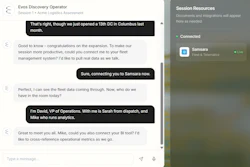
AI agents can flexibly interact with candidates around the clock—even scheduling follow-ups at unconventional hours like 3:00 a.m. when human staff are unavailable. While initial concerns centered on whether job seekers would resent talking to an automated agent, live demonstrations proved that drivers actively engage and appreciate the prompt responsiveness.
"The drivers really engage with it," said Hicklen. "They appreciate the quick response... and they almost treat it like a human being."