










Many of the well-known trucking technology companies in the market have recently been rolling out AI agents, autonomous software systems powered by large language models that aim to reduce manual human oversight and create greater operational efficiency by automating complex digital workflows.
Another player has entered the scene with a focus on small- to mid-size businesses in the physical economy, from manufacturers and warehouses to motor carriers.
Evolutionary Operating Systems Inc. (Evos) recently emerged from stealth mode with funding to launch its Workhorse platform. The company builds what it calls “autonomous operators,” but its modus operandi differs compared to standard AI chatbots or single-use agents.
[RELATED: Lytx unveils agentic AI features for its all-in-one platforms]
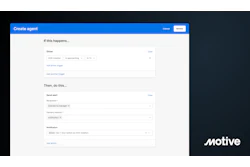
Many of the AI agents available in transportation management systems (TMS) today are set up using guided, rules-based templates, and some offer the tools that enable customers to create their own custom agents using plain-language interfaces. Evos operators don’t demand the constant prompting most AI tools require. Instead, it learns from a team’s behavior and decision patterns and begins fully functioning autonomously once its decisions consistently match the team's.
"The most capable system in many of these businesses is the person who has been there for 20 years, and what they know has never been written down," said Evos Founder and CEO Urav Shah. "An Evos operator learns the job from these people, improves on it, and proves it can match them before it takes on any work by itself."
How it works
The software sits on top of the TMS and other systems a company already uses, so there's no migration, and each customer gets its own custom-built model, trained only on its own data.
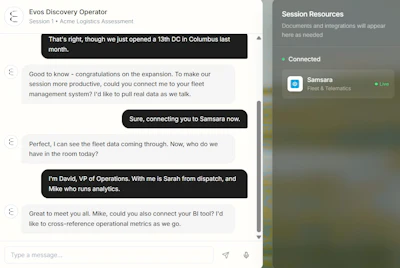
The process begins on the self-serve platform with a conversation with the Evos Discovery Operator, where a company’s operations team maps out its processes, pain points and the systems it uses and connects its tools and shares documents.

[RELATED: Why fleets must train employees to lead AI]
Evos analyzes that input to identify the highest-impact use cases, and the team reviews those findings and decides what recommendations to use. The platform then works with the team to map out a deployment strategy that establishes checkpoints, owners and outcomes before building individual operators configured and tested against the real workflows it will run.
 Evos operators monitor and resolve issues autonomously.Evos
Every decision goes to the customer’s team for approval at the start and then runs autonomously at the customer’s comfort level. The operator improves and expands scope with use, flags patterns and routes anything it doesn’t recognize to a human.
Use cases
The system performs tasks such as auditing carrier invoices, building loads, chasing paperwork and reconciling against the TMS.
Jack Spangler, Evos founding head of go-to-market, said the first function Evos built for a carrier handled broker communication, covering routine check calls, status updates and exception handling with the brokers they haul for.
“Every decision went to the carrier’s ops team for approval at first, and all three earned full autonomy within seven weeks, with routine check calls climbing from 77.7% approval to 97.3%,” Spangler said. “Between June and late August, it sent 348 emails across 170 loads and created zero loads outside the approved workflow in 80 days.”
The next function was load building, modeled against 430 loads the carrier’s own dispatchers entered. He said the operator matched the dispatchers’ decisions in 100% of graded comparisons.
[RELATED: Gartner survey reveals fragmented AI implementation prevents scalability]
Evos has one freight brokerage customers that uses an operator to audit every LTL carrier invoice against its TMS. The operator made nearly 3,500 audit decisions at 97% accuracy over a two-month period, and it closed out more than $600,000 of invoice value over a recent five-week period.
Spangler noted that Evos is currently designing five additional functions for its aforementioned carrier customer, including accounts receivable and invoicing, zero-miss backhaul, detention and accessorial recovery, exception and ETA, and load sourcing.
“For a carrier, the scope is whatever the dispatch desk, the ops team and the billing desk regularly handle,” he said.