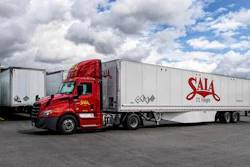











Early contract renewals and a January rate increase covering about one-third of revenue will lift base yield and shipment growth in 2027, according to FedEx Freight company executives.
FedEx Freight posted its first set of results as a standalone less-than-truckload carrier, reporting a 9.2% revenue increase to $3.3 billion for the four-month transition period ending Sept. 30, 2026.
The period includes June plus the three months ended Sept. 30, reflecting a one-time transition to calendar-year reporting following the company’s June 1 separation from FedEx (CCJ Top 250, No. 1).
Net income came in at $230 million, down from $404 million in the same period last year. Excluding spin-off costs, adjusted net income was $322 million, compared with $426 million a year earlier.
The first four months were focused on keeping customers through the separation, president and CEO John Smith said on a call with analysts. Monthly net revenue churn improved from 2025, both with and without fuel.
The company is now shifting from a “cultivating and making sure that we kept the business that we did have” strategy to a more stronger growth approach with a dedicated LTL sales force deployed regionally.
“Now we have transitioned into a hunting phase,” Smith said.
Target verticals include retail, data centers, healthcare, grocery, aerospace, automotive, as well as small and medium-sized businesses, which Smith called the company’s biggest opportunity.
Retail has the most traction so far, he said, while aerospace volume is up about 3%.
“We feel really good about the opportunity to continue the momentum that we started building these first four months,” Smith said.
[RELATED: Shippers are asking for multiyear contracts, ODFL says]
Pricing push for 2027
Pricing is a major part of that push. FedEx Freight has renewed about 25% of its contract portfolio since June 1 at what Smith described as its strongest renewal pricing in recent years. Roughly two-thirds of revenue comes from negotiated customer agreements.
A 6.9% general rate increase, announced in September, takes effect Jan. 8 and will apply to approximately one-third of the company’s revenue base.


Chief Financial Officer Marshall Witt said the regionally embedded sales team could help the increase stick longer than in past years.
“We understand that the GRI does not completely stick, and you lose traction over the period of months,” Witt said, adding that sales-rep relationships give the company a better chance to hold yield.
Volume trends and balance sheet
From June 1 to September 30, FedFex Freight reported total shipments of 7.64 million versus 7.66 million from the same period a year ago. Average tonnage per day of 41,683 tons remains largely unchanged from 41,702 tons the same time last year. Total tonnage increased 1% year over year to 3.58 million compared to 3.54 million last year, which executives attributed to improving freight environment.
Average daily shipments fell 1.4% to 88,900. Priority shipments held roughly steady, but Economy shipments dropped 4%.
FedEx Freight ended the period with $388 million in cash and $1.6 billion in total liquidity. The company repaid $100 million of debt ahead of schedule. Capital spending for the transition period is expected to total about $365 million.
Management plans to announce its dividend and share repurchase plan in January, subject to board approval.