










By combining western and eastern rail networks into a single transcontinental system, the proposed Union Pacific and Norfolk Southern transaction promises to slash diesel emissions, boost regional economic competitiveness, and transform the commercial freight landscape.
- Trucking and Logistics Shift: The merger is projected to pull 2.1 million truckloads off highways each year, cutting roughly 2.1 billion long-distance truck-miles while significantly relieving local drayage congestion in major freight hubs like Chicago.
- Economic and Consumer Savings: Shippers are expected to save $3.5 billion annually in lower logistics costs, creating long-term affordability trickle-down effects for everyday consumer goods.
- Public Health and Climate Wins: Cutting diesel emissions and 3.8 million metric tons of annual carbon dioxide could prevent up to 141 premature deaths per year, translating to billions in monetized health and environmental benefits.
- Regional Market Access: The creation of 88,000 new single-line county-to-county lanes—including 45,000 within the Mississippi watershed region—will enhance market access for underserved and persistent-poverty areas.
A proposed coast-to-coast rail merger between Union Pacific and Norfolk Southern could pull 2.1 million truckloads off American highways annually, creating a major shift for the commercial trucking industry while generating up to $5.8 billion in annual economic, climate, and public-health benefits, according to a new study by economist, impact investing specialist, and founder of Creative Investment Research William Michael Cunningham
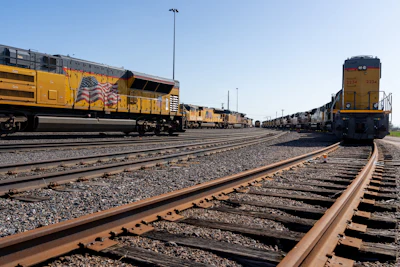
The transaction, currently under review by the Surface Transportation Board (STB), would fuse Union Pacific’s western footprint with Norfolk Southern’s eastern network. Proponents argue the resulting single-line service across 88,000 new county-to-county lanes will eliminate costly interline handoffs, alter long-haul logistics, and reshape freight competition nationwide.
Union Pacific and Norfolk Southern last December, in their merger filing with the STB, projected the combined UP/NS "will convert more than 2 million truckloads of traffic from long-haul trucking to rail... One freight train can replace several hundred trucks... We want to increase rail’s share of traffic and remove trucks from our highways."
The proposed $85 billion deal has the support of some of trucking's largest players, among them Knight-Swift Transportation, C.R. England, Hub Group, MODE Global, Knichel Logistics, and Schneider National.
Schneider earlier this month announced it is transitioning its eastern intermodal operations to Norfolk Southern in a strategic agreement designed CEO Jim Filter said allows his company to "pursue new freight and convert truckload shipments to intermodal."
Implications for commercial trucking
The merger presents a dual narrative of long-haul competition and short-haul adaptation for commercial truck fleets.
Cunningham's analysis estimates that shifting 2.1 million truckloads from asphalt to rails will eliminate roughly 2.1 billion long-distance truck-miles each year. While long-haul trucking companies could face increased competition for cross-country freight, the transition could relieve capacity bottlenecks in operations.


In Chicago, a pivotal national rail gateway handling roughly one million drayage shipments annually, the merger is projected to eliminate 250,000 to 500,000 local truck trips and cut 5 million to 15 million local truck-miles each year. Removing repetitive urban drayage movements could ease local truck parking pressures, reduce pavement wear on municipal streets, and mitigate driver hours-of-service losses spent idling in terminal congestion, the report noted.
The merger covers 50,000 route miles that connect 43 states and more than 100 ports.
Economic and public-health windfalls
Beyond freight logistics, the report quantifies substantial spillover benefits for consumers and communities:
Shipper and consumer savings: Lower-cost rail options are projected to save shippers $3.5 billion annually, savings that are expected to gradually flow down to wholesale and retail pricing for groceries, building materials, and manufactured goods.
Public health and mortality: By cutting an estimated 3.8 million metric tons of carbon dioxide emissions and curbing diesel exhaust, the modal shift could prevent between 47 and 141 premature deaths annually, with a central estimate of 94 lives saved. Monetized health benefits from reduced diesel pollution are pegged at $1.1 billion per year.
Regional competitiveness: In underserved regions such as the Mississippi Delta, the Black Belt across Alabama and Mississippi, and Appalachia—which account for 45,000 of the new single-line rail lanes—improved logistics access could yield up to $1 billion in annual economic competitiveness gains for local manufacturers and agricultural producers, according to the report.
Regulatory scrutiny
Total quantified benefits are estimated between $4.2 billion and $5.8 billion annually, translating to a 10-year present value of roughly $35.8 billion to $49.7 billion.
However, analysts caution that these projections depend heavily on actual operational integration. Stakeholders are expected to scrutinize whether the projected logistics savings translate into genuine rate reductions for shippers and whether rail operators will make enforceable commitments to terminal access, workforce development, and local infrastructure protection.