










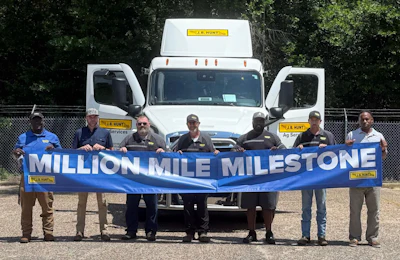
The American Trucking Associations’ 2026 National Truck Driving Championships celebrated 429 of America’s safest truck drivers who have accumulated more than 774 million crash-free miles. J.B. Hunt has a "Million Mile Walk of Fame" that in 2025 recognized 54 drivers with 2 million or more crash-free miles, including five with more than 5 million safe miles. The industry celebrates safe driving.
Data on safe driving, whether for passenger cars or Class 8 commercial trucks, never tracks the number of crashes that did not happen. The focus remains on the ones that do. We frequently hear claims that humans cause most crashes, as if viable alternatives have always existed. Until recently, they did not. Now we have autonomous vehicles, which rely on computer drivers.
Still, whether human or computer, the collisions prevented through driver diligence are rarely recorded, while crashes are scrutinized in detail.
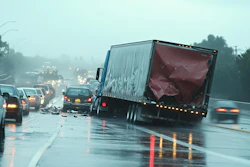
A human driving 1 million, 2 million or 5 million crash-free miles is an exceptional accomplishment. Yet data and experience show drivers generally complete their routes without an incident. High-dollar litigation and nuclear verdicts aside, Federal Motor Carrier Safety Administration data from 2022 indicates a 1.5-in-a-million-mile probability of a truck being involved in a reported crash. Put simply, there are roughly 1.5 crashes for every million miles driven.
A typical U.S. motorist drives roughly 13,600 miles annually. A typical commercial truck driver averages roughly 59,000 miles per year. Long-haul drivers operating at legal hours-of-service limits might log up to 175,000 miles a year if they average 600 to 700 miles per driving day. Most travel fewer than 100,000 miles annually due to traffic congestion, urban delivery schedules and loading dock delays.
While the statistical odds of an individual driver crashing on any given day remain relatively low, the legal system places intense focus on collisions when they occur. Safe driving rarely generates equivalent headlines, despite the industry's massive scale. In 2023, the Bureau of Transportation Statistics reported that combination trucks traveled nearly 195.8 billion miles, while straight trucks logged another 134.1 billion miles.

Driving a truck remains physically demanding. Anyone who has spent a week driving a 28-foot rental moving truck across the country at more than 500 miles a day can appreciate the physical toll of doing that work year-round. Even modern truck interiors with ergonomic seating take a cumulative toll on the human body.
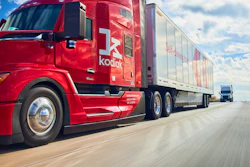
Enter the automated driver. A computer system experiences the physical jarring of the highway without human physical fatigue. It requires maintenance, hardware repairs and software updates over its operational life, but it does not wear down like a human operator.
An automated system also will not take pride in reaching a 1-million-mile milestone. While truck manufacturers will market the technical achievement, the ATA is unlikely to host banquets for software. The baseline expectation for autonomous systems is zero crashes. Any crash indicates either a system failure or an unavoidable edge case that overwhelmed onboard safety controls.
Autonomous vehicle engineers and investors will celebrate safe-mile milestones. Human drivers, independent owner-operators represented by groups like the Owner-Operator Independent Drivers Association, labor unions like the Teamsters, and freight railroads likely will not.
News media will likely cover early 1-million-mile milestones for autonomous commercial trucks, but public interest will fade quickly, much like coverage of the NASA Apollo moon missions did in the 1970s. Once achieved, the benchmark becomes an expectation rather than a novelty.
Will roads actually be safer?
Highway safety remains a shared responsibility. Drivers reach destinations safely because surrounding motorists cooperate. As autonomous passenger cars and commercial trucks enter the fleet, they will share roadways with human drivers of varying skill levels under unpredictable weather and road conditions. An autonomous vehicle's safety record will reflect both its internal systems and the actions of surrounding traffic.
It is difficult to predict whether mixed-traffic roadways will prove statistically safer overall. The broader rollout of advanced driver assistance systems in passenger cars should reduce truck-involved collisions, as passenger vehicles frequently precipitate multi-vehicle truck crashes.
Safer automated trucks should also lower incident rates by maintaining consistent following distances, tracking surrounding traffic accurately and adhering strictly to traffic laws.
Future roadways will feature a mix of technologies and behaviors: automated vehicles programmed to follow traffic regulations alongside human drivers who may choose not to.
Collisions will still happen. Neither human operators nor automated systems offer absolute perfection. A properly functioning autonomous truck can still be struck by an errant vehicle, pedestrian or animal.
All drivers—human or algorithmic—remain on a learning curve. Absolute perfection may be unobtainable, but continuous safety improvement remains the objective.