










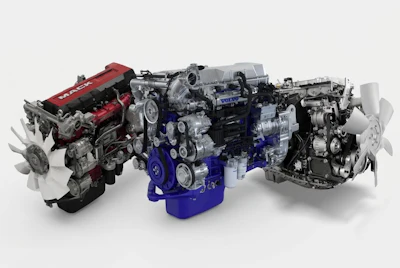
Volvo and Mack executives say they are prepared for the EPA 2027 standard with fully compliant 0.035-gram engines and upgraded uptime tech, though initial fleet orders are expected to favor existing legacy models.
- Only true 35mg engines in the field: While other OEMs plan to use emissions credits for regulatory compliance, Volvo and Mack engineered proprietary engines that directly hit the EPA's 0.035-gram NOx target.
- Dual-track ordering strategy: Recognizing customer hesitation around new emissions technology, both brands are giving fleets the flexibility to split orders between legacy powerplants and the new 2027-compliant engines.
- Supply chain pivot over engineering hurdles: The main operational challenge was not developing the 35mg technology, but quickly working with suppliers to extend production of legacy engines and truck models originally slated for retirement.
With the trucking industry bracing for the Environmental Protection Agency’s stringent 2027 emissions regulations, sister companies Volvo Trucks North America and Mack Trucks, along with International Motors, find themselves in a unique position: owners of true 0.035-gram nitrogen oxide (NOx) engines ready to meet a regulatory standard that technically doesn't even exist. Yet.
While the rule itself is not yet final, EPA's standards for model year 2027 require heavy-duty commercial vehicles to limit NOx emissions to 0.035 grams per horsepower-hour during normal operation. That final year is expected by year's end.
The prior rule had a firm compliance deadline, but the proposed rule expands the availability and flexibility of the credit system manufacturers use to meet regulatory averages and permits manufacturers to pay nonconformance penalties as a short-term alternative if they cannot immediately meet the hardware standards.
Other heavy truck and engine OEMs will rely on those emissions credits and/or penalties to temporarily bridge the regulatory gap as they ramp up sales of 35-milligram engines next year.
Cummins will introduce its new-for-2027 X15 through a gradual production wind up starting in January, while keeping select current-generation engines available during the transition.
Detroit will roll out its new sixth generation engine and will not offer current generation engines alongside it. Emissions credits will help push the engine across the 2027 compliance finish line.
"Our approach to meeting EPA 2027 requirements combines Detroit Gen 6 technology with the responsible use of emissions credits," the company told CCJ. "Credits are an established part of the regulatory framework and are widely used across the industry. They complement, rather than replace, our engineering efforts and support compliance across our product portfolio."
PACCAR will sell only its current generation MX engines for a undefined period of time next year.
Volvo, Mack, and International, however, said they are ready now to ring in the new year, each with an engine that is pending EPA certification once the final rule is published.

Magnus Koeck, vice president of strategy, marketing, and brand management at Volvo Trucks North America, noted that achieving the 35-milligram standard was a nonnegotiable target the company set years in advance.
"Volvo's philosophy has always been, first and foremost, we need to adhere to the regulations," he said. "You can be compliant in lots of different ways by using credits, and then you are technically compliant, but we have a true 0.035 engine."
"We are a technology company. We're all about compliance," added Mack Trucks President Jonathan Randall. "When the rule came out and it was 35 milligrams, we were going to be a 0.035 come hell or high water."
International President and CEO Mathias Carlbaum said the company's developmental approach to the 2027 regulation "was 100% to meet it" with "no slack in thinking this." Even as emissions regulations changed, or were struck down, and as uncertainty about the EPA's 2027 rule swirled, Carlbaum noted that "we kept the foot to the accelerator here. That's the target and that's what we developed toward."
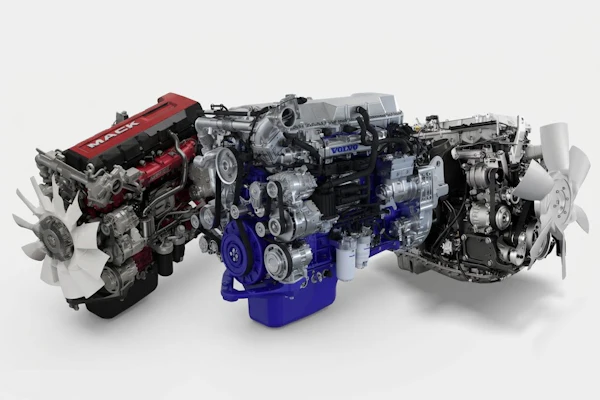
Rather than overhauling their respective platforms with new tech, Volvo and Mack each mostly refined their existing aftertreatment systems that have been in commercial use for over a decade to meet the 2027 requirement of 35 milligrams. Key pieces of Volvo's 2027 D13 and Mack's MP13 are the use of electricity to increase exhaust temperatures and more complete combustion cycles to reduce CO2, soot, and particulate matter.
Similarly, International's S13 for 2027 carries over 90% of the hardware from the current platform, but unlike Mack and Volvo, it does not include a 48 volt electric heater.
Comfort in flexibility
Despite the engineering milestone, the three OEMs will offer fleets a dual-path strategy for at least part of the upcoming year because the EPA's proposed rule gives manufacturers more time to validate the reliability of new emissions-control systems under real-world operating conditions.
Volvo and Mack will make available their new certification-pending EPA '27-compliant engines—which also boast improved fuel economy—alongside their legacy engines that meet current emissions standards.
"The NPRM allows customers to ease into the technology in a good way," Randall said, adding that he expects the 2027 order book to lean heavily toward current-emission legacy engines, at least initially. "The ones that are putting in orders, they're splitting it. More heavily toward the current emission standards, but still taking some of the 35 milligram because we know that's where eventually we're going to be."
Randall noted that current market hesitation isn't necessarily driven by a fear of the new technology itself, but by the typical industry desire to test new platforms in real-world fleet operations before fully committing.
"We will continue with the legacy engine, but still give customers the possibility to try out the 0.035, and we'll pass on the NCPs," Koeck added.
Supply chain hurdles
The flexibility to offer both legacy and 2027-compliant engines created mayhem behind the scenes. According to Randall, the primary challenge wasn't developing the 35-milligram engine; it was recalibrating the supply chain to continue building legacy models that were slated for retirement.
"We expected that we were only going to be building the new Granite and the new Anthem next year. Well, now we're building the existing Granite, the Pinnacle goes on at least into next year, as well as the new Anthem and the new Granite," Randall said. "The technology stuff was never really a big thing. We had the technology. It was more how do we meet the demand through the supply with product that we didn't think we were actually going to be building next year."
Carlbaum, too, noted that the regulatory delays pushed manufacturing supply chains "a couple of months" behind.
"The (2027 S13) engine is going to be available in engine manufacturing in April and on vehicles in May," he said, adding that the legacy engine will be available for a "very short" period before fully giving way to the 2027 model.
Impact on truck availability
Regulatory uncertainty hampered truck orders for much of the year, even as the trucking market marched toward financial recovery. Randall characterized that as the trucking business getting better than it had been the last few years, but not necessarily doing well thanks to higher operating costs.
An aging national fleet, however, will inevitably force buyers off the fence in the coming year.
"The fleet age is probably as old as it's been in a long while, and we're going to have to go into a replacement cycle for sure," Randall said. "I don't think it's a growth market. I think it's a replacement cycle market next year."
Koeck agreed that legacy engines are likely to make up the lion's share of next year's order book, and that replacement demand, not fleet growth, will drive order placement.
"The fuel efficiency, the maintenance savings," he said. "There's a lot of cost savings there [with a new truck] if you extended your trade cycle in the market downturn."
Carlbaum sees next year's market slightly differently, pointing to many fleets who deferred trade-ins over the past few years all coming back to the dealership lot next year.
"If I would place my bets today, '27 is above '26 in output," he said. "The replacement need is bigger than a normal replacement year."
Strong order activity late this year, he added, indicates "there's still a demand out there that hasn't been covered" by 2026 deliveries.