










Samsara is bringing its Agent Studio platform public, giving fleet and operations teams a powerful no-code tool to create tailored AI workflows that streamline daily tasks and safety management.
- Samsara has officially launched Agent Studio following an open beta period that began in June.
- The no-code platform allows customers and partners to build custom AI agents from scratch or use more than 25 pre-built templates focused on safety and maintenance.
- Early adopters across multiple industries are already leveraging the studio to automate complex administrative workflows, such as driver assistance, daily maintenance digests, and driver identification.
- Designed to adapt to specific operational needs rather than generic workflows, the studio integrates internal documents as a knowledge base and features a built-in performance dashboard.
Samsara is taking its new Agent Studio, control center that enables custom artificial intelligence workflows in minutes without IT or developer experience, public.
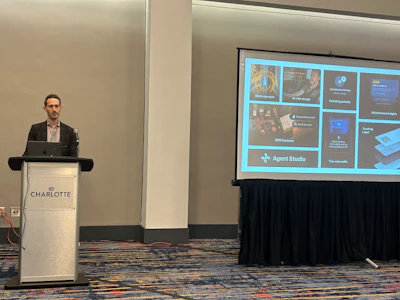
The platform's official launch at the American Trucking Associations’ Management Conference & Exhibition (MCE) Sunday follows an open beta testing period that opened in June.
Agent Studio allows customers and partners to create custom agents from scratch or use more than 25 pre-built templates focused on safety and fleet maintenance.
Eric Danko, Samsara's head of global public policy and government affairs, noted the platform is built on physical operations data "that lives inside of physical operations" and is "not just internet-Googleable." Within the studio, builders can toggle capabilities, configure settings, set permissions, and monitor usage.
Companies can integrate their internal policies and documents as a knowledge base, preview agent behaviors before deployment, and track outcomes using a built-in performance dashboard.
Early adopters across several industries are already using the studio to automate complex administrative workflows:
Driver assistance: A major food distributor deployed a "driver wingman" that answers questions regarding parking, weigh-stations, company policy, and escalations using dynamic location and company data, reducing communication time by 30 minutes per call.
Daily maintenance digest: A food bank utilizes a fleet briefing tool to provide operations teams with rapid updates on fleet status and vehicle inspection report compliance, eliminating hours of manual tracking each week.
Driver and vehicle identification: A field services company automated an assignment workflow that identifies moving vehicles with unknown drivers and links trucks to staff, mitigating insurance risks and reducing dispatch radio traffic.
"Agent Studio is really the first platform that helps physical operators say, 'How did that occur in each of these three areas?'" Danko said, highlighting that the tool is designed to adapt to specific operational needs rather than forcing businesses into generic workflows.
Post-testing discoveries
Since launching its open beta in June, Danko said Agent Studio has experienced a rapid acceleration in customer adoption, highlighting a fundamental shift in how physical operations engage with artificial intelligence.
The first half a million prompts processed through Agent Studio took 112 days (roughly a third of a year), Danko said, while the most recent half a million prompts were completed in just 16 days—a 7X acceleration in adoption.
Fully one-third of customers who have activated Agent Studio are utilizing two or more custom agents for their daily operations, he added.
Deployed use cases include:
Inspection and compliance reporting: Grand Isle Shipyard utilizes an agent to consolidate forms, inspection records, and asset details into monthly divisional summaries in roughly five minutes, achieving a 99% decrease in generation time and saving the team about $100,000 annually in specialist resources.
Predictive compliance: S. Bertram Foods employs an agent that monitors remaining shifts, drive times, and stops to identify hours-of-service compliance risks three hours prior to a violation occurring, lowering weekly manual review hours by 84%.
Driver identification: StreamTech Industrial utilizes an agent to track trips lacking a driver login, successfully cutting unassigned driving time by 500 hours over a two-month period.
Fuel efficiency: An agent deployed by a prominent North American passenger transit company examines vehicle idling to separate fuel waste driven by human behavior from weather patterns, maintenance, and regeneration cycles, giving managers clear direction on which assets require intervention.
Company-specific driver support: A large food distributor developed a "Driver Wingman" agent capable of answering new drivers' inquiries regarding fuel stops, parking, and personal conveyance guidelines using internal company policies instantly at any time of day.
The rise of voice


Within just a month of launch, voice interaction surpassed chat as the preferred interface for users, with usage among voice customers continuing to double as operators manage tasks on the move.
According to Danko, users are developing agents capable of placing and receiving phone calls, integrating real-time operational data and internal company policies into these interactions to provide support outside of standard office hours.