










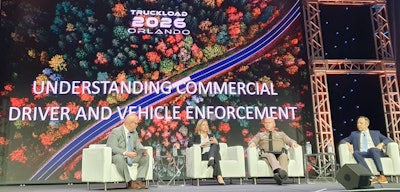
It’s an era of enforcement, according to panelists at the Truckload Carriers Association Truckload 2026 convention in Orlando this week.
The panel, echoing earlier sentiments of FMCSA Administrator Derek Barrs, highlighted stronger coordination of enforcement on commercial driver training and licensing regulations.
Andrew Poliakoff, executive director of Commercial Vehicle Training Association, pointed to one example of stronger enforcement: the Entry Level Driver Training (ELDT) regulations, in effect since February 2022, which set the baseline for training requirements of all entry-level drivers to obtain a Class A or Class B CDL for the first time.
Poliakoff said those regulations initially were not being enforced.
“These organizations created what we call the ELDT Task Force. We began a hearts and minds campaign, pounding the table, cajoling, persuading, begging the FMCSA to take action on that. And nothing happened," he said.
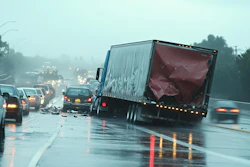
A fatal crash involving Harjinder Singh in Florida was the catalyzing event, Poliakoff said. What followed was a sweeping industrywide enforcement action. Poliakoff described "1,500 training providers audited over one week by 300 FMCSA inspectors that resulted in a more than 30% failure rate. A random audit with a 30% failure rate.”
CDL mills
Non-compliant training providers have been a long-standing industry issue, with panelists emphasizing that two- and three-day CDL mills represent a real danger.
“Our job is to take the bad actors off the road, whether it’s a driver or motor carrier… They’re out there every day looking for those bad actors,” said Adrienne Gildea, deputy executive director of Commercial Vehicle Safety Alliance (CVSA).
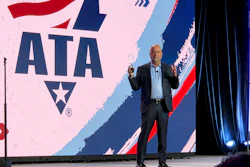
Poliakoff noted that eliminating CDL mills reduces excess freight capacity created by substandard operators, which American Trucking Associations Chief Economist Bob Costello said earlier at the convention is what will drive a supply-based freight recovery.
[RELATED: USPS to remove unvetted non-domiciled drivers from trucking fleet]

ELP and non-domiciled CDL
The enforcement of English Language Proficiency was met with speed, Gildea explained.
"There was an executive order with a 60-day turnaround," Gildea said. "Our board acted in an emergency function, got the out-of-service criteria out in May with the guidance that FMCSA had developed, and it became effective in June."
The first six or so months was "a little bit all over the place," she said, but by January, all were enforcing it.
Erick McGuire of Commercial Vehicle Enforcement for Florida Highway Patrol said Florida struggled in the early months of the ELP regulations enforcement.
"We had to get together. We came up with some training from our training department, and we issued a training statewide in a very quick manner... There really wasn't any intel from any jurisdictions,” he said.
McGuire said they talked closely to Southeast Georgia and Alabama to try to get some of their intel on enforcement of the new ELP regulations then. Since there wasn’t any intel on it, McGuire said they started tracking it.
“It was very odd, very strange, trying to get through some of the steps… so we had a lot of learning [on ourselves. But we actually have moved forward,” he said.
On non-domiciled CDLs regulation enforcement, McGuire said other states present hard challenges.
“We've seen some other states where it just shows the last name; the first name is not given — things like that. So, of course, we dig a little deeper. It takes a little more time. We get some federal agencies involved to try to run those systems," he said.
ELD fraud
Another central issue for CVSA is ELD fraud, Gildea said.
"You've got what we affectionately call ghost drivers — that's just like a second set of logbooks, essentially," she said. "But then we're also hearing more and more instances where the logbooks have been manipulated on the back end by somebody... The driver is calling back to somebody, and that person is going in and cleaning up their books for them, which is obviously not allowed."
As advancements in enforcement techniques rise, Gildea said bad actors figure out ways to evolve too.
What compliance looks like for carriers
For carriers conducting their own training and facing audits, Poliakoff said documenting proficiency is critical.
He also flagged the state-level compliance layer that many carriers overlook: “In order to comply with federal entry-level driver training law, you need to comply with the state laws that govern your truck driver training in the state that you operate in. That could be within the Department of Education, within the Department of Labor... These are all agencies and sub-agencies at the state level that are bandwidth-constraining to put it politely."
Good carriers, McGuire said, have figured it out: it’s taking care of your people, good quality instruction, and consistent training.
Enforcement isn’t just about removing bad actors, Poliakoff said, but about building something better.
“If you give a market certainty by removing bad actors, you also professionalize the industry. Why can't we get more women into the trucking space? It's like we need to professionalize this industry," he said. “And frankly, what better way to do it than to know that there are no people out there with these two- and three-day training organizations — it's the entire overhaul of the space."