










The Mississippi Senate race has finally been called by the Associated Press, landing the Democrats with another seat, while results in Alaska are still undetermined. While the reality is Democrats will control Congress in January, many efforts surrounding trucking regulation remain bipartisan as both sides grapple with the soaring costs affecting the trucking industry.
Nevertheless, the election will have an impact on the Trump Administration’s aggressive set of enforcement policies on things like CDL licenses and schools, ELDs and English Language Proficiency, said American Trucking Associations Vice President of Safety Policy Brenna Lyles.
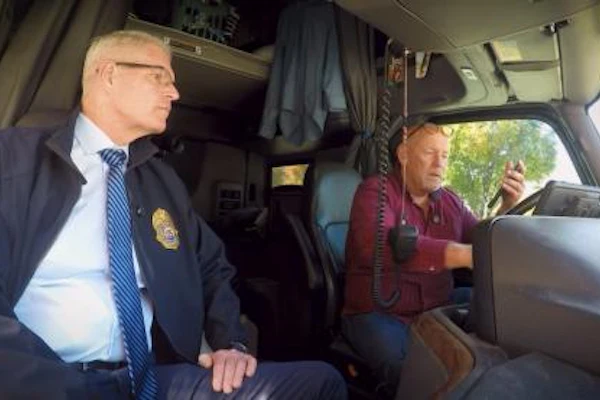
Lyles shared her behind-the-scenes insight last week to a roomful of fleet representatives at the Fleetworthy Roadshow event held in Nashville.
“I think there will be a sense, even amongst Democrats, that they want to preserve some of the safety and enforcement efforts that have already been happening. I think there is consensus on certain things: doing away with chameleon carriers, some of the fraud, ELD fraud,” she said. “I think there are bipartisan issues for sure, and then there are some things that are maybe a little more hot-button and have been not loved by the left that could come into question.”
[RELATED: FMCSA will 'hold violators fully accountable' after ELD fraud scandal revealed]
Lyles spoke heavily about the Montgomery v. Caribe ruling and how that could impact carrier safety scores with Fleetworthy Vice President of Corporate Strategy Rob Abbott, who once held the role Lyles is in now.
For decades, property brokers had successfully fended off state-level negligent selection lawsuits by invoking the Federal Aviation Administration Authorization Act of 1994, arguing the federal law preempts state regulations affecting broker rates, routes and services.
Those days are over, according to Chad Krueger, vice president and managing director at Central Analysis Bureau (CAB) by Fusable, as the high court determined that personal injury and negligent selection claims fall squarely within the federal statute's safety exception, preserving state authority over motor vehicle safety. The SCOTUS ruling dismantled the procedural early-exit ramp brokers previously used to secure pretrial dismissals, ensuring that future broker liability lawsuits proceed directly to discovery and jury trials.


What is a safe carrier?
The ruling put greater accountability on brokers to hand over freight only to carriers that are considered safe and responsible, but Abbott noted without any guidance.
Abbott said brokers are “very concerned” and asked Lyles if fleets — not just for-hire fleets but also private fleets doing backhauls — should care, too.
“Yes,” she said. “In some ways this kind of puts brokers on level footing when it comes to lawsuit abuse and the nuclear verdicts that motor carriers face, but I think it's also putting new pressure on motor carriers to prove their safety in some cases, and brokers are inevitably going to look for a standard to follow.”
Lyles affirmed that there is currently not a uniform standard.
“There have been efforts, both legislatively and regulatorily, to create something,” she added. “Right now, we're just seeing brokers individually come up with a standard that's based on ... data from FMCSA.”
She noted that many solutions have been popping up in the absence of a clear standard, an example being vetting platforms that pull from multiple data sources, including the FMCSA, and use a proprietary algorithm to determine a somewhat arbitrary score. She also highlighted the pros and cons of that.
Sure, they’re promoting roadway safety if the platform’s standard is really high, she said, but it could also be screening out motor carriers that are truly safe because the safety data isn’t there or reflective of that. If the bar is too low, she added, then they're just shielding brokers, and it's a checkbox exercise.
“I can tell you what ATA is doing, and that is thinking a lot about how to deal with this, and we've just started the process of setting up a working group internally so that we can go through this very complex exercise of thinking about what it means to be a safe carrier,” Lyles said
Where’s the data?
Abbott noted that this could put greater renewed emphasis on the reliability of Federal Motor Carrier Safety Administration Compliance, Safety, Accountability (CSA) scores, which are often used as a metric in those calculations, but Lyles said those scores were designed to prioritize motor carriers for roadside inspections and intervention, not to make decisions on whether they're a “rubber-stamp” safe carrier or not.
“I think the agency is clearly already feeling the pressure. They've indicated that they'll be reviewing and hopefully putting forward some kind of proposed changes to (USDOT) SMS (Safety Measurement System),” Lyles said. “We had something that was supposed to move forward in 2024, so it’s hard to say whether they'll just pick up the mantle there and move forward with that or start over completely.”
One of the major issues with the system, Abbott noted, is it simply lacks data on so many carriers. North of 60% of carriers have no data in the system whatsoever, and north of 80% don’t have enough to generate a score, he said, adding that a big reason for that is there aren’t enough roadside inspectors: 3,000 compared to the six million trucks on the road.
“They're doing about 3 million inspections annually, so that's, on average, once every other year a truck gets inspected. But I think many of the fleets in this room — you could attest to that — some of your trucks get inspected more than once a year. That means like 4 million trucks will never get inspected this year, maybe 5 (million),” Abbott said. “One way to make that more efficient is to do what we've done in tolling. We're no longer throwing a quarter in the bucket. At highway speed, we're taking data from the truck. So, conceptually, you could do that for truck inspection data.”
Lyles said the Commercial Vehicle Safety Alliance has been working towards a pilot for something like that and that the FMCSA also has interest.
The idea, she said, is to obtain more inspection data in real time and in motion to alleviate the need for personnel to physically pull trucks over and to use that data to populate motor carrier scores. But Lyles said things haven’t yet been worked out to determine how fleets will get credit for those inspections at highway speeds, noting that full credit would be difficult to justify because there are still things those types of inspections would miss, like if the driver is wearing the eyeglasses he’s supposed to have on, for example.