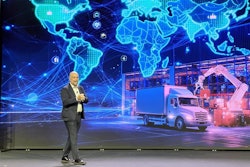
If you can’t make money with one truck, you can’t make money with more than 1,000 trucks. That’s the aphorism from his mentor that Dave Williams, senior vice president of equipment and government relations at Knight-Swift Transportation (CCJ Top 250, No. 3), shared during a recent panel at Truckload 2026, held last week in Orlando.
The measure of success was once based on the number of trucks a company operated, said Pete Hill, executive vice president at Hill Brothers Transportation (No. 244). But that’s no longer the yardstick.
“It slowly turns around to, ‘Are you making any money?’ And yes, I'm making a lot more money at the level we are now than when we were almost twice the size,” Hill said.
Hill, along with panelists Dennis Dellinger, president and CEO of Cargo Transporters (No. 167), and Mike Ludwick, president and CEO of Bison Transport (No. 37), delved into the metrics that actually equate to success for trucking companies amidst an enduring freight downcycle.
Managing fleet size in a downturn
American Trucking Associations (ATA) chief economist Bob Costello was quick to temper carriers’ excitement for the economy last week at the Truckload convention. The freight recession of the last three years is hanging on.
Some supply-side corrections have occurred due to capacity leaving the market, but he urged carriers not to run out and buy new more trucks because demand hasn’t quite returned.
Dellinger said that although Cargo Transporters has added to its fleet, it hasn’t returned to its pre-COVID size. “It's about running those trucks profitably,” he said.
Ludwick said Bison has found other ways to grow its business—diversifying into other services and markets—without adding trucks, and has actually reduced its fleet size over the past couple of years.
“We haven't organically grown the business in probably half a decade or more. We don't intend to,” Ludwick said. “We still feel we can consolidate some opportunities and not add to capacity, but help use it to grow our business. I don't like truck count... That isn't the only marker of growth,” Ludwick added. “Are you growing your skills? Are you growing your bottom line? Are you growing capabilities so that you're ready for the next round of opportunity that comes?”


Preparing for the upswing
Williams asked the panelists what indicators they look for to identify that next round of opportunity.
“We haven’t seen it yet,” Hill said, noting that his company has been in survival mode, focusing on lowering costs and increasing efficiencies and driver productivity during the downturn.
But Hill said when rates improve, that is what will give him the confidence that the freight economy is on the mend.
Though it can be a useful gauge for the overall economy, Dellinger warned against looking at the Consumer Price Index because it can be inflated by services, which can’t be loaded onto a truck. He said the index could be positive, but his business would still be stalled.
For Ludwick, the indicator that the cycle has turned is customer demand.
“We receive a lot of orders via EDI (electronic data interchange) every day, and we don't take them all,” Ludwick said. “We look at this EDI rejection rate quite a bit in our business; we were normally rejecting 100 to 200 orders a day. On Monday, we rejected 2,000 orders. There's something there to be looked at in terms of real-time indicators of what's happening,” he said.
Long-term vision
Whether he’s managing his company through an upcycle or downcycle, Dellinger said he always has his eye on one metric that gives him insight into how his company is performing: people. He said he looks at recruitment and turnover. But it’s not just about drivers.
As Cargo Transporters pushes through the current downcycle, Dellinger said his staff’s move of late has been to accept what loads they can get. Though he operates with a lean staff, he said many of his employees have never experienced an upcycle, so his focus is on educating his people about how to act or react when that time comes.
“My focus the last three years is trying to focus on the people side of things: growing the people, mentoring the people,” Dellinger said. “If you take care of your people, the profits will come.”
Ludwick said having people who can guide the business through changes is critical. He said Bison has made some investments in technology so it can stay ahead and relevant in the future, but the company is also being restrictive on investments, preserving its ability to capitalize on the future.
Hill noted that hiring “smart, young people with a different perspective” will define a carrier’s ability to navigate evolving technological changes.
Dellinger drilled home that long-term success lies in the hands of his employees. He said it’s important to hire the right people, especially people who think differently than you, to strengthen your team.
“The ones that will survive and thrive are the ones that build strength before they need it,” he said.