










What is Driving New Truck Orders
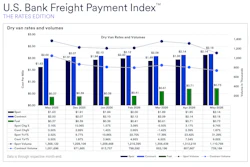
Demand is primarily being fueled by soaring freight rates that are rapidly improving carrier profitability, ongoing fleet replacement needs, tightening capacity, and "pull-forward" buying by fleets trying to secure vehicles before strict new EPA 2027 emission regulations take effect.
Preliminary North American net orders for Class 8 heavy-duty trucks surged in June, driven by soaring freight rates and a rapidly recovering trucking market, according to FTR and ACT Research.

Data from FTR placed preliminary net orders at 30,500 units—up 16% from May and up 241% year over year. ACT Research reported its preliminary June Class 8 net orders at 31,400 units, representing a 231% jump from the same period last year. Both firms noted that the massive year-over-year percentage gains were amplified by a very weak comparison period in 2025. Prior-year comparisons have now exceeded 100% for five consecutive months.
According to FTR, June orders tracking 68% above the 10-year average for the month reached the second-highest June net order total in the firm's history.
"Underpinning the seven-month run of strong Class 8 order activity has been the ongoing, supply-lead and demand-supported recovery in the trucking industry," said Carter Vieth, research analyst at ACT Research. "As we say, truckers only buy trucks when they make money. Underscoring the rapid change in carrier fortunes, freight rates continue to soar."
The strong intake adds to an already dense backlog, suggesting either higher-than-expected manufacturing builds through the end of the year or orders spilling heavily into the first half of 2027.
Year-to-date orders have jumped 125% year over year, and the 2026 order season—spanning September 2025 to June 2026—is cumulatively pacing 36% ahead of last season. Over the past 12 months, total Class 8 orders reached 334,160 units.
Analysts expect remaining 2026 build slots to completely fill during July, shifting the market's focus from an order-driven phase to a capacity-allocation phase. Moving forward, policy developments rather than underlying commercial demand are expected to serve as the primary swing factors for fleet timing into 2027.
"June orders confirm that the Class 8 cycle remains constructive, as monthly intake continues to surprise to the upside," said Dan Moyer, senior analyst of commercial vehicles at FTR. "The bigger question now is not demand but how much of the 2026 backlog converts to production before uncertainty over the EPA, tariffs, and USMCA reshapes fleet timing for 2027."

The possibility that orders are already spilling into early 2027 slots raises the stakes for impending Environmental Protection Agency regulations. The White House has cleared proposed revisions to the EPA 2027 NOx standards, with publication expected soon.
While some of the strong orders are surely due to EPA regulatory clarity, Jason Miller, Eli Broad Endowed Professor of Supply Chain Management at Michigan State University, added "we are clearly in fleet expansion territory."
"Make no mistake, it will take time for these trucks to be built and seated," Miller added. "Given we are already in the second half of 2026, I don’t see a significant infusion of truckload capacity coming this year, [though] we may start to see some capacity trickling in by Q4. More substantial capacity increases are likely in 2027, though."
 This chart plots year-over-year percent change in new orders on the left y-axis and year-over-year change in total truckload linehaul spot rates on the right y-axis using the average of the two readings as the denominator for the percent change calculation. The strong positive correlation that characterized the period prior to terrible component shortages in 2021 has returned. When linehaul spot rates rapidly increase compared to the prior year, Class 8 truckload orders follow.Jason Miller, MSU
While the industry expects the EPA to retain the 2027 start date and strict 0.035 g/hp-hr NOx limit, it is anticipated to soften provisions related to warranties, useful life, and credit trading.
"With 2026 demand exceeding build slots, an increasingly important question is EPA’s enforcement posture in the early months of the regulation," Moyer said.
A primary concern is whether the rules will include non-conformance penalties (NCPs), their financial size, and their duration. If the cost of these penalties is significantly lower than the price of the new 2027 NOx emission hardware, manufacturers may find it easier to slot excess customer demand into the first half of 2027.
Trade policies also present potential friction. While the United States-Mexico-Canada Agreement (USMCA) currently limits the impact of Section 232 truck and parts tariffs, a July 1 milestone means any of the three member nations can now withdraw from the trade agreement with six months' notice. Prolonged trade uncertainty could expose more North American manufacturing content to higher costs.
Meanwhile, medium-duty commercial vehicles also experienced substantial growth. ACT Research reported that preliminary Classes 5-7 net orders rose 67% year over year to 20,700 units in June.

Vieth attributed the medium-duty demand to ongoing U.S. economic resilience, but noted underlying friction within that segment. "Given near-record-low consumer sentiment and the very real sticker shock hitting small-to-medium fleets, this month’s medium-duty orders appear to be driven largely by dealer inventory stocking ahead of 2027," Vieth said.