










I awoke one morning recently to a winter weather advisory. It got me humming the classic Sam Cooke song, Chain Gang.
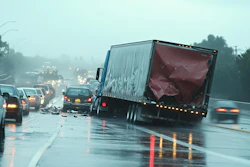
Winter driving in mountains will inevitably encounter a requirement for chaining up your truck. Driving Interstate 5 through Shasta, Calif., a few years ago, I encountered a Caltrans/CHP roadblock just north of Redding where I had to confirm I was carrying chains. Within 15 miles I wished I had them on as the blizzard conditions had drastically covered the road in snow. It was evening, darkness and temperatures fell quickly, as did snow, and I wisely grabbed the first exit to a hotel in Shasta for the night. All night long I heard the relentless clang of semi-trucks with chains doing what they do—getting the load to its destination in all conditions, going over the 4,310 ft. Siskiyou summit, while I safely waited the storm out in a warm hotel.
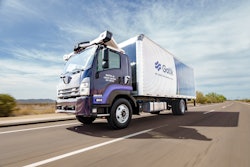
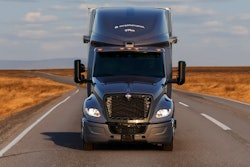
It made me wonder how autonomous freight trucks will deal with unpredictable weather conditions in the future. How will they navigate roads that are marginally visible to human eyes in night snow conditions? How will the trucks know they have to stop to install chains? How will the trucks get chains installed? How will frozen air lines get cleared? How do the sensors get cleaned of ice and snow? Each question leads to more questions.
Siskiyou Summit is the highest point along the entire length of Interstate 5. Grades up and down can exceed 6%. Truth be told, though, that’s not very high. Passes in Colorado like the I-70 Eisenhower Tunnel exceed 11,000 ft. Idaho’s I-15 gets up to 5,118 ft. Montana’s I-90 reaches 6,329 ft. Utah’s I-15 hits 6,611 ft. And even the east coast in West Virginia has one peak at 4,860 ft., and Tennessee has one on I-40 that reaches 7,320 ft. Chaining up is a reality in many parts of the country, even flat Texas outside Amarillo at an elevation of 3,600 ft. can necessitate truck chains in winter. And then there is Canada with passes in Albert exceeding 7,000 ft.
Chaining up may be considered by autonomous vehicle (AV) researchers as a “edge case,” something that happens “out of the ordinary.” Only it happens frequently and somewhat unpredictably, nearly everywhere, nearly every year.

What will your freight network do when their autonomous fleet needs to chain up to keep freight moving?
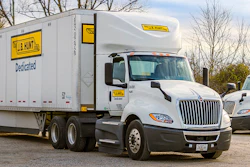
For those AVs already on the road heading to their destination, an unplanned snowstorm likely means the truck will stop, somewhere where the road conditions have degraded. Most likely not at a convenient truck stop or exit. I expect the AV system designers will have them safely move to the side of the road and park on the edge of the highway, with brake lights flashing. They will dutifully wait for their sensors to clear snow, ice and road grime. They may wait for remote instructions on what to do. They may wait for a human service attendant to come, install chains, and maybe drive them to their destination.
On the other hand, those AV tractors sitting in the yard, when road conditions go awry may get human drivers. I struggle a bit with this one as no fleet will have a room full of seasonal drivers sitting around, and when storms hit, every fleet may need to tap the available pool of local drivers that don’t have assignments yet. For those trucks parked at the side of the road somewhere, somehow, the human drivers will have to get to the truck, so likely it requires two people and another vehicle to get one driver to the stranded truck.
The available seasonal emergency driver pool becomes even more of an issue in our world where licensed, legal drivers are in short supply. What happens to all those loads when the snow storms hit and several of the interstates have chain requirements? Rerouting may not be possible.
System flow will back-up. Do you recall in 2021 the pictures of container ships stacking up in the Ports of Los Angelese/Long Beach? It will be like that, except loads will be sitting in warehouses waiting for human drivers. Or maybe the technologists at the AV companies will magically solve all-weather driving conditions and add more technology to each truck so they can deal with bad weather conditions.
All that new AV capability will come with cost. One has only to look at the sensor package on a 1950s DC-3 passenger plane versus a recent 737-MAX to see where safe automation sensor technology will need to go to enable safe auto-piloting of semi-trucks. That new technology also will add new maintenance issues and will require more technician training and specialized equipment in the service shops.
Let’s jump forward to when AVs are truly autonomous. I don’t know when that will be, but likely some years from now. The roadway infrastructure will have been upgraded and designed to enable safe AV operation. That infrastructure will have received public and private funding to be maintained and continuously updated over many years. Seasonal roadway conditions will require seasonally available trained and certified workforces to assist the AVs in doing things like chaining up for ice and snow. Fleets and shippers will reserve funds all year so they can pay for seasonal work forces, facilities and equipment centers. The state and federal governments may create special seasonal licensing and certification to deal with the potential seasonal spike demands for winter weather drivers. In mild winters there may be no deployments of these seasonal workers or use of their facilities. And then there will be years where atmospheric rivers and winter bomb cyclones may abound.
The real world is full of edge cases like these.
- Dense fog conditions often seen in New Mexico and the central valley in California.
- High wind conditions that can topple rigs often occur in Wyoming and Texas.
- Hurricanes and floods of biblical proportions are not infrequent and impact interstate commerce routes.
- Landslides seem to regularly make the news from excessive rain events.
- Even earthquakes have been known to disrupt interstate infrastructure.
They are rare occurrences, but stuff happens in the real world.
The key word in AV is autonomous. Autonomous technically means self-aware. SAE tends to redefine AV vehicles as “automated and connected,” reflecting that these vehicles are not yet human. SAE reserves the term autonomous for some future where vehicles think for themselves, make their own decisions on the fly, where they intuitively decide where they are going and how to deal with situations.
As AVs roll-out into real-world operations, with the current level of technology in the highway infrastructure, with real-world traffic and weather, they will encounter edge cases. Fleets and shippers that have a growing market case for AV use will invariably encounter situations where they have to insert humans into the operations.
Forward thinking system planners should start figuring out how that seasonal workforce will be staffed, trained, equipped and paid for. AVs are more than the truck; they are part of a complete end-to-end freight system that needs to keep the freight moving, every day, irrespective of the edge cases it will inevitably encounter.