










A big piece of land with 500 truck parking spaces might would knock a tiny dent in the national truck parking crisis in America. But Trucker Path Chief Marketing Officer Chris Oliver said he would rather see 50 locations with 10 parking spaces each spread across the country.
“Then you're more likely to be where the driver needs you to be when you need to be there,” Oliver said. “As those hours of service start to weigh down, you're not always a half hour away from a giant parking location with 500 spots. You're often in different places, so having smaller pockets more ubiquitously placed across the geography is, in my opinion, the answer.”
It’s no secret that truck parking is a major issue, impacting supply chain efficiency, driver health and safety, cargo security and productivity, among other effects.
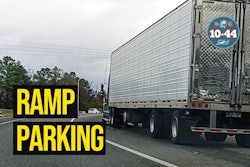
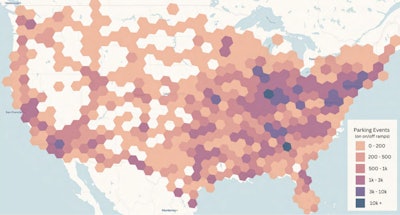
Truck parking was drivers’ No. 2 concern and motor carriers’ No. 9 concern among the American Transportation Research Institute's (ATRI) most recent Top Industry Issues. And according to Altitude by Geotab’s annual study of interstate ramp parking, approximately 330,000 long-duration, heavy-duty truck ramp parking events occurred nationwide between Nov. 1, 2024 and Oct. 31, 2025 with Indiana, Illinois and Tennessee and Atlanta, Indianapolis and New York-Newark ranked as the top three states and metro areas, respectively, with the most ramp parking events.
But technology is making a big difference in not only providing truck parking data but analyzing that data to identify the best places for infrastructure investment – a necessity following the recent $200 million in federal funding earmarked solely for the expansion of truck parking.
Build it, and they will come
Trucker Path, an app for the trucker community, has 29,000 truck parking locations marked in its app. The app prompts its users to advise on parking availability when they break the geofences around these locations. Users click on and “digitally visit” those 29,000 points of interest 27 million times per month, and the app receives 1.9 million parking availability reportings on those locations each month.

“Parking locations and their availability is one of the most clicked upon data points within Trucker Path, and it's also the most shared crowdsourced information that we have,” Oliver said, adding that the data it gathers on those parking locations provide some general insight into areas where parking is most needed.
Altitude also provides insight into parking needs, provided by the more than 100 billion data points gathered from all the vehicles across Geotab’s ecosystem.
Users can interact with the platform to drill down into specifics like vehicle class type and engine type; vocational use, including long-haul, local, regional, hub and spoke, or door to door; industry like transportation and warehousing, construction, agriculture, etc.; road type like limiting the search to interstates with on- and off-ramps; and location with the ability to look at a specific state, nationwide or a custom zone. The platform also allows users to set thresholds. For example, they could run an analysis to understand where Class 8 trucks stop for eight hours.
“You can get that level of detail and really start pinpointing some of the context, rather than just anecdotally see a lot of trucks (at a particular ramp),” Nathaniel Veeh, associate vice president of business development at Altitude, said during a recent chat with CCJ at the annual Geotab Connect conference. “Rather than that, they could actually use that, plus the other measurements behind it to understand what's actually going on and like, ‘okay, this is a smart investment for me.’”
The platform helps public and private entities identify high-demand parking areas for investment, helps inform regulations, and helps trucking companies with route optimization, cost-benefit analysis and driver retention.
Finding parking
Another platform, called Streetline, just wrapped up its first year working with the Arizona Department of Transportation in which it registered nearly 2,000,000 parking events in the state, providing drivers with real-time visibility into available spaces in rest areas along the Interstate 10 corridor. The AI-powered smart parking platform’s 95% accuracy rate was driven by camera-based AI, machine learning and cloud analytics that delivered real-time per-space availability for truck parking near rest areas; consistent, validated accuracy across varying weather, lighting and traffic conditions; seamless integration with DOT systems and traveler information platforms; and actionable data to support long-term freight planning and infrastructure investment.
The platform has since deployed in eight states.
“For truck drivers, reliable access to safe parking isn’t a convenience; it’s a critical necessity,” Arizona Trucking Association President and CEO Tony Bradley said in a news release. “Over the past year, the I-10 Truck Parking Availability System has made a real difference by providing drivers real-time information to schedule their daily breaks, support hours-of-service compliance, and make safer decisions at the end of a long day. We applaud Arizona Department of Transportation and Streetline for delivering a viable solution that improves safety and gives drivers greater confidence on the road.”
Oliver said an ATRI study from a few years ago discovered that drivers spend upwards of 45 minutes looking for parking on a daily basis. Trucker Path surveyed its user base in Q4 2025, asking how long it takes them to find parking using the app. The answer was 19 minutes.
 The Trucker Path app identifies parking along drivers' routes.Trucker Path
Identifying prime locations to build new parking is only one part of the equation, Oliver said, adding that more parking is great but only if drivers can find it.
Trucker Path shows drivers parking within a default radius as part of its free version. With a paid subscription, drivers can see the likely parking status at locations they are traveling to in the future based on historical data.
“There really are two sides to this. One is building enough spaces, which you know is happening and will take a while, but the other side is just making them discoverable and understanding if there's really any parking there,” Oliver said. “That second side is where we come in … We're not building parking spaces; we're just making them discoverable.”