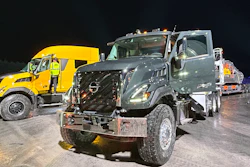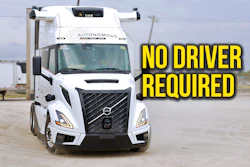











Benjamin Ramsay said he expects to see more exciting headlines in 2026 about large carriers deploying autonomous trucks in their real-world operations, though it will be many years before AVs are within practical reach for smaller operations like Tradewinds Logistics, which has downsized its fleet in recent years to about 25 trucks and shifted focus to warehousing and 3PL services.
But that’s not the hottest topic of 2026.
The experts all agree that artificial intelligence takes the cake. The trucking industry saw a drastic increase in AI announcements in 2025. That has been the case throughout the first month of 2026 and is expected to continue.
[RELATED: Geotab's 2026 prediction: AI-driven boom for fleets that adapt]
“As much as AI has blown the world's collective mind in the last few years, there is still nothing that gives me the feeling that I'm living in the future as much as watching driverless trucks, hauling real freight on real roads in real traffic with no one behind the wheel,” said Ramsay, who serves as vice president of technology at Tradewinds.
“AI is obviously the hottest topic in our industry – or just about any industry – right now … I consider it the most potentially transformative advance (in technology) I've seen in my career … and we're still only in the early stages. It will be extremely interesting to see what the future of AI brings to the trucking industry and the world.”
But AI is still in the “goldrush” period with new AI-centric startups popping up regularly and every established technology vendor finding ways to inject AI into their feature set and marketing campaigns, he said.
Top considerations for AI implementation
Though Ramsay thinks some of the excitement and expectations for AI will come back down to earth a little bit this year, he said there are two trucking-specific AI applications that stand out to him that he will consider implementing at Tradewinds.
One is AI-powered dash cameras because they provide real-time alerts to help prevent crashes rather than simply providing insight into an accident after the fact and coach drivers in the moment rather than powering a driver scorecard that gets reviewed monthly.


According to Motive’s 2026 AI Road Safety Report, 2026 will mark a tipping point where AI-powered, real-time intervention – not post-incident analysis – becomes the primary driver of collision reduction.
The other technology Ramsay is interested in is predictive maintenance tools powered by AI analysis of crowd-sourced data.
“For a smaller company like ours, there isn't enough maintenance data to draw broad predictive maintenance recommendations from our own repair history alone, but tools that combine shared anonymized data from thousands of similar vehicles on the platform give a small fleet access to insights that could prevent a major breakdown and keep our trucks on the road,” he said.
“As a smaller carrier, I see a lot of value in platforms that combine the anonymized data of all their users to benefit everyone, whether that be for preventative maintenance, lane rate trends, detention time predictions or any of the other many pooled-data applications out there. There's a big opportunity for smaller operations to gain access to large-scale insights that might otherwise only be available to the mega-carriers of the world.”
Trimble is heavily focusing its AI on the maintenance front with Trimble Road Call, which uses AI to handle driver calls when they’ve experienced a vehicle breakdown and create repair orders, and TMT Fleet Maintenance Invoice Scanning Agent, which uses AI to automate the manual process of entering repair order data.
“(Road call) takes out the time it takes to interview a driver, and it lets the driver talk to an AI agent, which sounds just like a natural person, but it'll capture it and go all the way to creating the vendor repair order,” said Brian Mulshine, senior director of TMT product management for Trimble. “It's taking fleets seven and a half minutes per invoice to enter it, and they're doing about 500 invoices a month. With (TMT Fleet Maintenance Invoice) Scanning, it cuts it in half.”
Tech experts see AI transforming other areas within and beyond maintenance, too.
Steve Blough, chief supply chain strategist at supply chain execution engine Infios, mentioned these areas are ripe for AI:
• Processing billing
• Load and route planning
• Load management (how freight is placed in a trailer)
• Managing driver schedules
• Yard management and scheduling
“Today, users sort of manually build their own insights and take action,” Blough said. “I think as the year progresses, this is where things will speed up: AI will start to not just predict but prescribe what to do and then eventually actually do it.”
[RELATED: Trucking tech throwback: top trends in 2024]
Blough said many carriers, especially smaller operations, still operate very manual processes, but he expects to see greater investment in technology this year.
M&A's impact on tech
As economic pressures on trucking companies abate, volumes should rise and reinvigorate interest in transportation technology investments, said Scott Mattson, head of the technology vertical and leader of the transportation and mobility technology team at financial advisory firm Brown Gibbons Lang & Company.
And he said he expects to see more new tech solutions come to market driven by an anticipated increase in M&A activity among trucking tech providers, specifically within broker transportation management systems and telematics companies, as they become more comfortable with the economic environment.
“If you're considering implementing a new software solution, whether it's a replacement of something that you have existing or an entirely new solution, there is, I would say, a hesitancy around not only doing so in a down market, which is certainly what we've experienced in freight for the last couple of years, but also when there's a lot of uncertainty around what the impact of AI is going to be on these different solutions,” Mattson said.
But he said there’s no doubt that AI drives efficiencies.
Some fleets have created their own AI-driven tech solutions to optimize efficiency, but Ramsay said Tradewinds and other small fleets likely won't be creating their own custom LLMs or replacing major staff responsibilities with agentic AI.
“We're more interested in the low-hanging fruit that AI already does well, using off-the-shelf AI tools to automate mundane tasks,” he said.
Those tasks include organizing scattered data into more readable formats; summarizing documents, meetings, and long email threads; and pulling information from paper and PDF documents and automatically populating systems to avoid manual data entry.
“These are pretty basic use cases and certainly not on the bleeding edge of what AI can do, but they are opportunities to reliably remove repetitive, mindless tasks from our team and free them up to do more important, thoughtful work,” Ramsay said.
Beyond AI, Ramsay said he expects to see fleets continue to move away from heavy on-prem systems toward cloud-hosted, web-based, mobile-friendly SaaS products and trucking software vendors to continue to move toward more unified platforms, bringing disparate systems for things like routing, dispatch, billing and maintenance altogether in one place. He said he is also interested in exploring telematics-powered insurance in 2026 to help lower costs.